Essential Equipment Safety Training: Electrical, Forklift Inspection & Operation Across Saudi Arabia
Home /Essential Equipment Safety Training: Electrical, Forklift Inspection
Home /Essential Equipment Safety Training: Electrical, Forklift Inspection
In the bustling industrial zones of Jubail, the expanding logistics parks of Riyadh, and the busy ports of Jeddah, two universal elements power Saudi Arabia’s economic growth: electricity and material handling equipment. Yet these essential tools—when not properly understood or maintained—become silent threats in workplaces across Dammam, Khobar, and every Saudi city. At Global Arab, we’ve seen how comprehensive Electrical Safety Awareness Training, rigorous Forklift Inspection Certification, and clear Forklift Safety Guidelines transform these necessary tools from potential hazards into pillars of productivity and safety.
This comprehensive guide explores why these three training areas form the foundation of operational safety in Saudi Arabia’s diverse industries. Whether you’re managing a warehouse in Riyadh, supervising maintenance in a Jubail petrochemical plant, or operating in Jeddah’s commercial centers, understanding electrical hazards and forklift operations isn’t just regulatory compliance—it’s essential for protecting your most valuable assets: your people and your operations.
Saudi Arabia’s rapid development under Vision 2030 creates unique challenges:
Energy-Intensive Growth: From NEOM’s smart cities to traditional industrial expansion, electrical systems are becoming more complex and pervasive.
Logistics Revolution: As Saudi Arabia positions itself as a global logistics hub, forklift operations have multiplied in warehouses, ports, and distribution centers across all major cities.
Diverse Workforce: The multinational workforce requires training that transcends language barriers through clear visuals, hands-on practice, and simplified concepts.
Climate Considerations: Extreme heat in Riyadh, humidity in Jeddah, and industrial corrosion in Jubail and Dammam affect both electrical systems and forklift performance.
Regulatory Evolution: Saudi standards are increasingly aligning with international benchmarks, requiring documented competence in both electrical safety and forklift operations.
Global Arab addresses these realities through localized training programs that combine international best practices with Saudi-specific applications. Our trainers in each region understand local conditions, regulations, and industry needs, ensuring our Electrical Safety Awareness Training, Forklift Inspection Certification, and Forklift Safety Guidelines training delivers immediate, practical value.
Electricity is the lifeblood of modern industry, but it doesn’t tolerate mistakes. Unlike many hazards that give warning signs, electricity strikes silently and instantly. Global Arab’s Electrical Safety Awareness Training isn’t just for electricians—it’s for anyone who might encounter electrical hazards: maintenance workers, machine operators, supervisors, and even office staff in facilities with complex electrical systems.
Our training builds understanding across three critical dimensions:
1. Understanding Electrical Hazards (The “Why” Behind the Rules):
How Electricity Causes Harm: We explain in simple terms how shock, arc flash, and arc blast occur—not as abstract concepts but as physical realities that trainees can visualize and respect.
Recognizing Hidden Dangers: Training focuses on identifying hazards beyond obvious exposed wires: damaged cords, overloaded circuits, wet conditions near equipment, and improper grounding—common issues we see in Saudi workplaces.
Saudi-Specific Conditions: How extreme heat accelerates insulation degradation, how dust and sand infiltration creates fire risks, and how humidity in coastal cities like Jeddah and Dammam affects electrical safety.
2. Safe Work Practices & Controls:
Lockout/Tagout (LOTO) Procedures: The cornerstone of electrical safety. We don’t just teach the steps; we teach the mindset through realistic scenarios from Saudi industries. Participants practice placing locks and tags until it becomes instinctual.
Safe Approach Distances: Understanding “limited approach boundaries” and “arc flash boundaries” through practical demonstrations, not just theory.
Tool and Equipment Safety: Proper use of insulated tools, voltage testers, and personal protective equipment (PPE) for electrical work.
Emergency Response: What to do—and critically, what NOT to do—when someone is being electrocuted. How to safely disconnect power and administer CPR.
3. Roles and Responsibilities:
Differentiated Training: We tailor content based on whether participants are “qualified persons” (authorized to work on electrical systems) or “unqualified persons” (who must recognize and avoid hazards).
Supervisor Responsibilities: How to plan electrically safe work, verify competencies, and ensure proper procedures are followed.
Facility Management: Understanding the requirements for electrical safety programs, documentation, and compliance with Saudi Electricity Company and regulatory standards.
In Riyadh & Central Regions: Training emphasizes managing electrical loads during peak summer demand, preventive maintenance for aging infrastructure, and safety in high-rise building electrical systems.
In Jeddah & Western Province: Focus includes corrosion prevention for electrical components in humid coastal environments, port electrical safety, and special considerations for historical district renovations.
In Jubail, Yanbu & Eastern Province (Dammam/Khobar): Industrial electrical safety takes center stage—high-voltage systems, process control electrical safety, and managing electrical risks in hydrocarbon environments where flammable atmospheres may be present.
Across All Regions: We address the challenges of temporary electrical installations common on construction sites—proper grounding, weather protection, and load management.
“Before Global Arab’s Electrical Safety Awareness Training, our maintenance team in Dammam saw electricity as something only our electricians needed to worry about,” says Ahmed Al-Mansour, Facilities Manager for a manufacturing plant. “Now everyone from machine operators to cleaners recognizes electrical hazards. Our near-miss reporting for electrical issues has increased 300%—not because we have more problems, but because people now see what they were missing before. That awareness alone has prevented several potential serious incidents.”
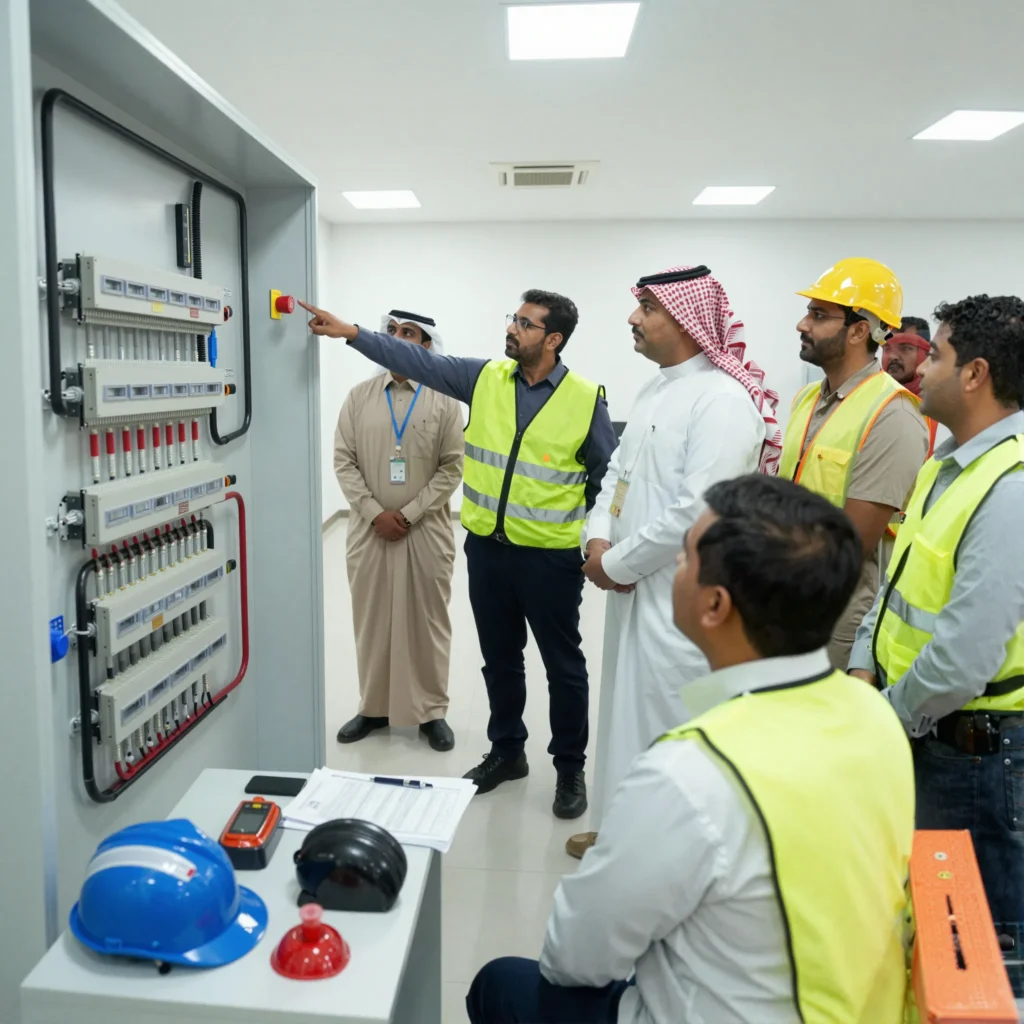
A forklift is only as safe as its condition allows. In Saudi Arabia’s demanding industrial environments, rigorous inspection isn’t just a regulatory requirement—it’s a moral imperative. Global Arab’s Forklift Inspection Certification program transforms inspection from a rushed paperwork exercise into a systematic, life-saving process that catches problems before they cause accidents.
Our certification focuses on developing true inspection expertise:
1. Pre-Shift Inspection Protocol (The Daily Lifesaver):
Systematic Approach: We teach a consistent sequence—walk-around, operational checks, documentation—that becomes habitual.
What to Look For (Beyond the Obvious): Trainees learn to identify subtle signs of trouble: slight hydraulic leaks, unusual tire wear patterns, hairline cracks in forks, and frayed seatbelts.
Functional Testing: How to properly test brakes, steering, hydraulics, and safety devices like horns, lights, and backup alarms.
Documentation That Matters: Creating inspection reports that actually communicate issues to maintenance teams and supervisors.
We deliver internationally recognized safety training and professional inspection solutions.
From workplace safety to equipment compliance, our certified experts ensure quality and trust.
Serving Saudi Arabia and the Gulf region with global standards.
Your safety, knowledge, and success are our priority.
