Home / Workplace Safety Training
The Gulf region—comprising countries like Saudi Arabia, UAE, Qatar, Oman, Kuwait, and Bahrain—has become a global hub for industries such as oil & gas, construction, manufacturing, logistics, and healthcare. With rapid industrialization and mega projects shaping the future, the importance of workplace safety training Gulf has never been greater.
Every year, thousands of workers across the GCC face occupational hazards ranging from construction site accidents to heat-related illnesses. Governments and organizations alike are now enforcing strict health, safety, and environment (HSE) policies to ensure employee well-being and international compliance. But compliance alone is not enough—what’s needed is a culture of safety that empowers employees to take proactive steps in preventing accidents.
This is where workplace safety training becomes vital. Training equips employees with the knowledge, confidence, and skills to identify hazards, follow safe practices, and respond effectively in emergencies. For businesses, investing in structured safety training programs results in fewer accidents, reduced downtime, stronger reputations, and increased productivity.
In this article, we’ll dive deep into the importance of workplace safety training in the Gulf, explore key goals, discuss industry-specific challenges, highlight best practices, and explain how Global Arab supports organizations in achieving long-term safety success.
Employers are investing heavily in HSE training courses in Saudi Arabia to meet international and local saudi standards, reduce accidents, and improve employee well-being. Whether you’re an employer, safety professional, or an individual seeking career growth, choosing the right course can significantly enhance your skills and employability.
The Gulf region isn’t just connected by geography; it’s linked by an unprecedented industrial boom. From the futuristic skylines of Dubai and the FIFA-ready infrastructure of Qatar to the giga-projects of Saudi Arabia and the industrial expansion in Oman, one universal requirement echoes across every boardroom and construction site: demonstrable, certified competency in workplace safety.
For a professional in the region, confining your job search to a single country is like fishing in a pond when you could be casting a net in the ocean. A Gulf-wide recognized safety certification does more than just qualify you for a job—it makes you a valuable asset to multinational contractors, engineering firms, and government entities that operate across borders. It’s your ticket to career mobility and resilience in the world’s most dynamic economic landscape.
The Gulf region is unique because of its mix of industrial diversity and environmental challenges. From skyscraper construction in Dubai to offshore drilling in Saudi Arabia, every sector faces risks that require targeted training solutions.
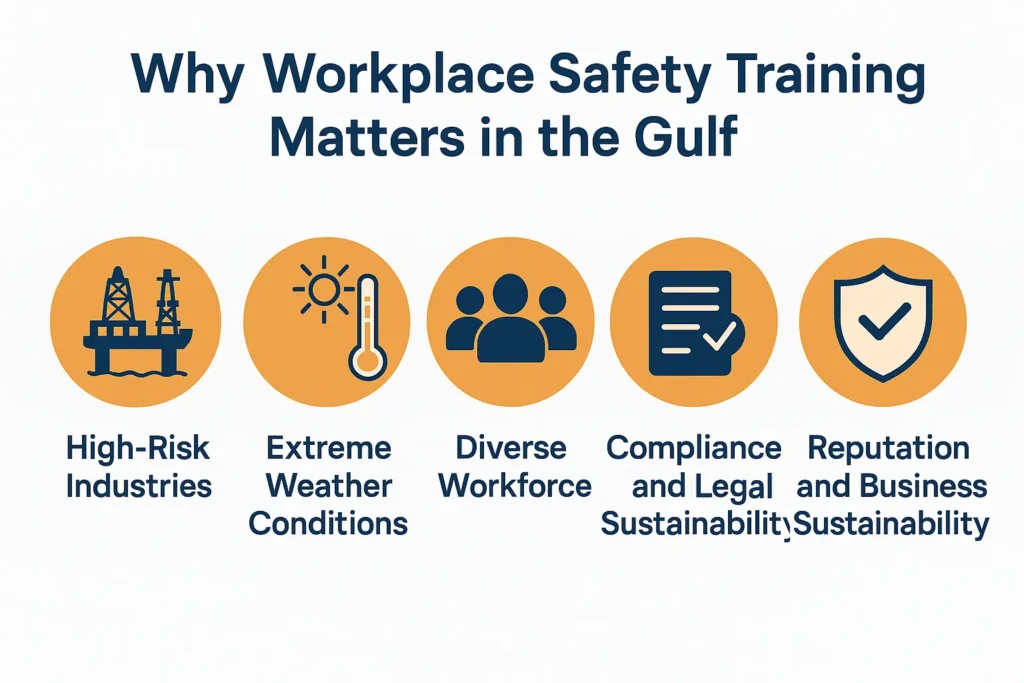
Here are the key reasons why workplace safety training Gulf is critical:
The Gulf is home to some of the world’s largest oil fields, refineries, and mega infrastructure projects. These industries involve heavy machinery, chemicals, and hazardous environments, making proper training essential for accident prevention.
Heat stress and dehydration are major occupational risks in the Gulf. Outdoor workers, especially in construction and oil fields, are vulnerable to sunstroke, fatigue, and long-term health issues if not trained in preventive measures.
The Gulf workforce includes people from multiple nationalities, languages, and cultural backgrounds. Training programs must be designed to overcome language barriers and deliver safety knowledge in clear, practical ways.
Gulf governments enforce strict labor and safety regulations. From Saudi Arabia’s Ministry of Labor to the UAE’s Ministry of Human Resources & Emiratisation, companies face penalties, fines, and shutdowns for non-compliance.
In today’s world, safety is also about branding. Global investors and partners are more likely to work with companies that demonstrate strong safety records.
United Arab Emirates (UAE): A hub of innovation, where safety protocols must adapt to everything from high-rise construction to advanced logistics. Key authorities include the Ministry of Human Resources & Emiratisation (MOHRE) and various Free Zone authorities. Safety here is about pace and precision.
Saudi Arabia: The scale is monumental. With Vision 2030, safety is not just a priority but a precondition. Compliance with Saudi Aramco’s Contractor Safety Management System (CSMS) and Saudi Civil Defense regulations is non-negotiable for anyone in the oil, gas, and construction sectors.
Qatar: Building on the legacy of the World Cup, Qatar maintains world-class infrastructure standards. Safety professionals here must be well-versed in Qatar Construction Specifications (QCS) and the requirements of the Ministry of Labour.
Kuwait & Oman: These nations are experiencing significant growth in their oil, gas, and industrial sectors. Safety practices are deeply rooted in rigorous risk assessment and compliance with their respective Ministries of Oil and Labour.
Our training doesn’t just give you a certificate; it gives you the contextual intelligence to apply your knowledge effectively, whether you’re on a site in Dammam, a plant in Sohar, or a high-rise in DIFC.
Setting clear safety training goals ensures programs are effective and measurable. The primary objectives of workplace safety training Gulf include:
Different Gulf industries face unique risks. Effective training must address these sector-specific concerns:
Oil & Gas نفط والغاز
Construction بناء
Healthcare
Manufacturing and Logistics تصنيع والخدمات اللوجستية
By tailoring workplace safety training Gulf to these sectors, companies can significantly reduce risks.
We’ve trained thousands of safety professionals across the GCC, and we’ve learned that effective training must be as mobile and adaptable as the workforce it serves.
One Certification, Six Countries: Our courses are meticulously designed to meet and exceed the core safety requirements across all GCC nations. We teach you the international framework (OSHA, IOSH, NEBOSH) and then show you exactly how to apply it under KSA, UAE, Qatari, and Omani regulations.
Instructors Who Have Been in Your Shoes: Our training team isn’t just academically qualified; they are veterans who have managed safety for major projects with Aramco, ADNOC, and QP. They bring you real, gritty stories from the front lines of Gulf industry.
Your GCC Professional Network: When you train with Globalarab, you don’t just gain knowledge; you gain a network. You’ll connect with peers and instructors from across the region, opening doors to opportunities you might not find on a job board.
To build a robust program, Gulf organizations should cover the following safety training modules:
Training is only valuable if it produces results. Gulf companies can measure safety training effectiveness by:
Leadership must demonstrate commitment by prioritizing safety in decision-making and rewarding safe behavior.
Since Gulf workforces are multilingual, training should be offered in multiple languages and use visuals, demonstrations, and real-life examples.
Workers learn best through hands-on practice, mock drills, and simulations instead of just theoretical presentations.
Training should be updated regularly to reflect new risks, technologies, and legal requirements.
Employees should feel safe reporting hazards or suggesting improvements without fear of consequences.
A: This is one of our most common questions. The answer is a resounding yes, provided the certification is from an internationally recognized awarding body like NEBOSH or IOSH. These are global gold standards. What our training adds is the crucial local context, teaching you how to implement those standards within the specific regulatory framework of Saudi Arabia, Qatar, or any other GCC state.
A: For mobile professionals like you, the NEBOSH International General Certificate (IGC) is the perfect fit. It’s the most widely recognized qualification for operational-level managers across the Gulf. It provides a robust, transferable foundation that is respected by clients and authorities in every emirate and province.
A: Salaries are competitive throughout the region, often tied to the specific project and company. However, professionals with a recognized international certification like NEBOSH or IOSH consistently command a 20-35% premium over their non-certified peers, regardless of the country. Your certification is your leverage.
A: Our differentiator is localization. Many providers offer the international certificate. We offer that plus the unwritten curriculum—the understanding of local laws, cultural nuances in implementing safety, and the specific expectations of the major national oil companies and contractors. We prepare you for the Gulf as it really is.
At Global Arab, we provide tailored solutions to help Gulf companies achieve their safety training objectives and comply with international standards. Our services include:
By partnering with Global Arab, organizations in the Gulf can reduce accidents, improve compliance, and build long-term reputations for safety excellence.
We deliver internationally recognized safety training and professional inspection solutions.
From workplace safety to equipment compliance, our certified experts ensure quality and trust.
Serving Saudi Arabia and the Gulf region with global standards.
Your safety, knowledge, and success are our priority.
