Home / Working at Height, Confined Space & Scaffolding Safety Training
In the rapidly transforming skyline of Saudi Arabia, from the stunning towers of Riyadh to the mega-projects rising in NEOM, three critical safety disciplines stand between progress and peril: working at dizzying heights, entering confined spaces, and building the very structures that make this work possible. For companies and workers in Jeddah, Jubail, Dammam, Riyadh, and Khobar, mastering Working At Height Training Courses, Confined Space Training, and Scaffolding Safety Training isn’t just a regulatory requirement—it’s the foundation of a safe, productive, and sustainable future aligned with Vision 2030.
At Global Arab, with dedicated training centers and mobile teams across the kingdom, we see firsthand how these specific skills directly impact the safety culture on Saudi projects. Falls from height, incidents in confined spaces, and scaffold-related accidents consistently rank among the top causes of serious workplace injuries. Yet, with proper, localized training, they are also among the most preventable. This comprehensive guide explores why investing in these three interconnected training areas is crucial for any organization operating in Saudi Arabia’s unique and ambitious environment, with specific insights for each of our key service regions.
Saudi Arabia’s unprecedented growth brings specific challenges that make specialized training essential:
Architectural Ambition: Vision 2030 projects feature innovative designs with complex heights and access challenges.
Industrial Legacy & Expansion: The established industrial heartlands of Jubail and Yanbu, along with facilities across Dammam and Khobar, contain thousands of vessels, tanks, and confined spaces requiring routine entry for maintenance and inspection.
Climate Considerations: The extreme heat, wind, and occasional sandstorms in regions like Riyadh and Jeddah add unique layers of risk to working at height and on temporary structures.
Evolving Workforce: A diverse, multinational workforce requires clear, practical, and hands-on training that transcends language and cultural barriers.
Global Arab‘s approach is built for this context. We don’t just import international standards; we adapt them to the realities of the Saudi worksite, ensuring our Working At Height Training Courses, Confined Space Training, and Scaffolding Safety Training are immediately applicable and effective.
The definition is simple yet profound: working at height means any work where a person could fall a distance liable to cause personal injury. This encompasses everything from a technician on a rooftop in Khobar to a window cleaner on a high-rise in Riyadh, or a welder on structural steel in Jeddah. Global Arab‘s Working At Height Training Courses are designed to instill not just competence with equipment, but a genuine “height safety mindset.”
Our courses, delivered locally in each city, are built on several foundational pillars:
1. Risk Assessment & Planning (The “Think Before You Climb” Approach):
Hierarchy of Controls: Training participants to first ask, “Can this work be done from the ground?” before considering fall protection.
Site-Specific Risk Assessment: How to evaluate unique hazards in different Saudi environments—high winds in coastal Jeddah, extreme heat in inland Riyadh, or complex access in dense industrial Jubail.
Selection of Work Methods: Understanding when to use ladders, mobile elevated work platforms (MEWPs), or rope access techniques.
2. Fall Protection Systems & Equipment Competence:
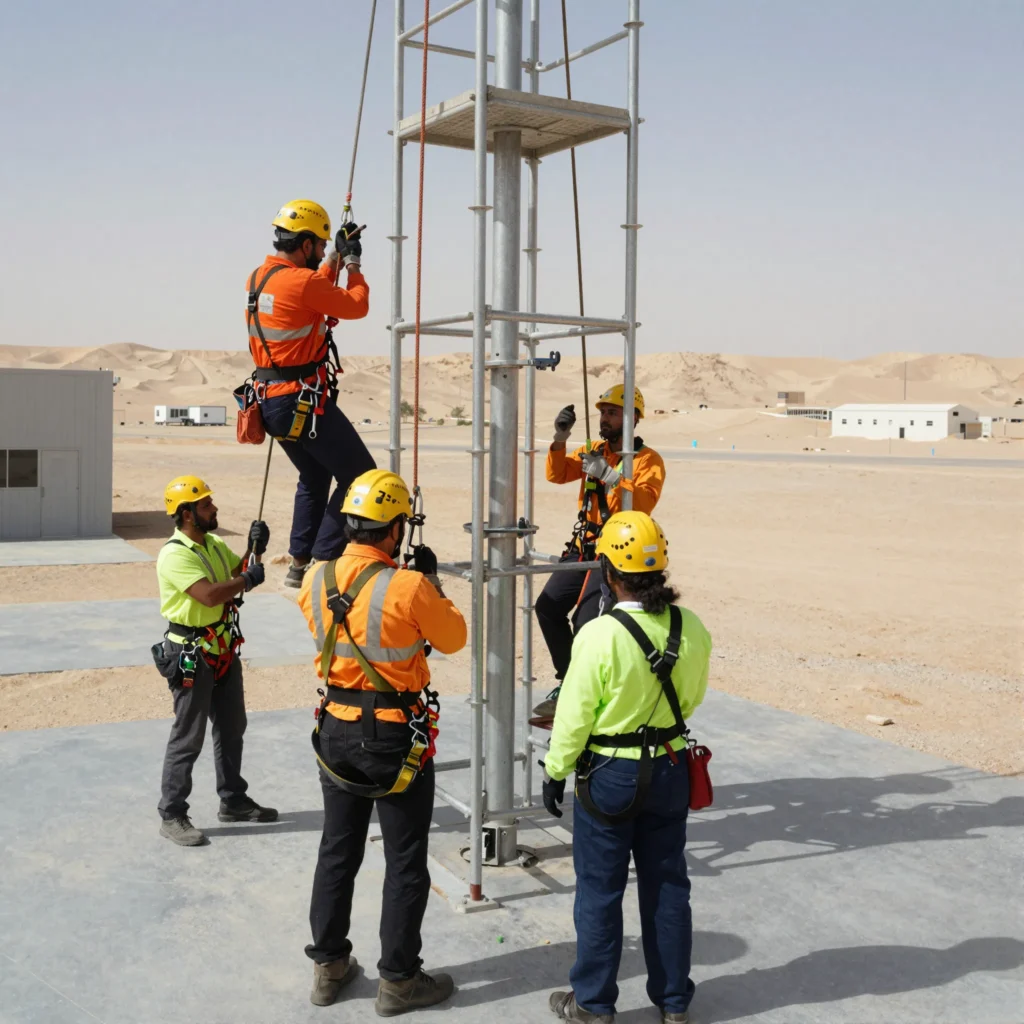
Personal Fall Protection Equipment (PFPE): Detailed training on full-body harnesses, lanyards, energy absorbers, and anchor points. We emphasize hands-on fitting and inspection—a poorly fitted harness is a deadly hazard.
Collective Protection: Installing and using guardrails, safety nets, and soft landing systems effectively.
Equipment Inspection & Care: Teaching workers to conduct pre-use checks and understand the lifecycle of their safety gear, crucial in Saudi’s harsh climate which can degrade materials faster.
3. Practical Skills & Emergency Preparedness:
Safe Ascension/Descension: Techniques for ladders, fixed ladders with safety cages, and scaffolding.
Tool Tethering & Dropped Object Prevention: A critical module, as falling tools are a major hazard to those below on busy Saudi construction sites.
Fall Arrest Scenario Training: What actually happens during a fall? We use controlled environments to demonstrate the forces involved and the importance of proper setup.
Basic Rescue Awareness: What to do if a colleague is suspended in a harness. Prolonged suspension can cause fatal “suspension trauma,” making prompt rescue a vital part of the training.
In Riyadh: Training addresses the challenges of ultra-high-rise construction and maintenance, focusing on swing stages, building maintenance units, and managing heat stress while working elevated.
In Jeddah & the Western Region: Coastal wind conditions are a major factor. Courses emphasize wind speed monitoring, securing materials, and emergency procedures for sudden weather changes.
In Jubail, Dammam & Khobar (Eastern Province): The focus extends to the petrochemical and industrial sector—working on tall vessels, cracking towers, and pipe racks within live plants, where fall protection must be integrated with other hazards like fire and chemical exposure.
“Before Global Arab’s Working At Height Training Courses, our teams in Dammam saw harnesses as just another piece of paperwork,” says Engineer Hassan Al-Mutairi, a project supervisor. “Now, they understand the physics of a fall. They inspect their gear meticulously. They plan their anchor points. The mindset shift from compliance to genuine safety has been remarkable.”
A confined space is not defined solely by its size, but by its hazards: limited entry/exit, and the potential for a hazardous atmosphere (toxic, flammable, or oxygen-deficient). In Saudi Arabia’s vast industrial landscape—from storage tanks in Jubail to sewage manholes in Jeddah or boiler units in Riyadh power plants—these spaces are everywhere. Global Arab‘s Confined Space Training prepares workers not just to enter, but to understand, control, and survive these high-risk environments.
Pillar 1: Recognition & Hazard Assessment
Beyond the Definition: Training workers to identify non-obvious confined spaces (open-top chambers, pits, degasifier vessels).
Atmospheric Hazards: The core of the training. Understanding gas testing for oxygen, flammability, and toxicity (especially Hydrogen Sulfide, common in Saudi oil and gas).
Physical & Engulfment Hazards: Moving parts, extreme temperatures, and the risk of being engulfed by materials like sand or grain.
Pillar 2: The Permit-to-Work System & Roles
A confined space entry permit is a lifeline, not paperwork. We train all roles:
Entrants: On recognizing hazards, using equipment, and communicating.
Attendants (“Hole Watch”): Their critical, non-entry role in monitoring, maintaining count, and initiating emergency procedures.
Entry Supervisors: The legally accountable individuals who authorize entry, ensure conditions are safe, and terminate permits.
Pillar 3: Equipment & Atmospheric Control
Ventilation Techniques: Practical use of blowers and exhausts to create a safe breathing atmosphere.
Personal Protective & Monitoring Equipment: Proper use of supplied-air respirators, multi-gas detectors, and communication devices.
Isolation (Lockout/Tagout): The absolute necessity of isolating all energy sources (electrical, mechanical, pneumatic) before entry.
Pillar 4: Rescue Planning & Execution
“Non-Entry Rescue is the Primary Goal”: Training emphasizes retrieving a downed worker using tripods, winches, and retrieval systems without sending more people into danger.
Practical Rescue Drills: Teams practice setting up equipment and performing retrievals under simulated stressful conditions.
Coordination with Emergency Services: Understanding what information site rescuers must provide to municipal civil defense units when they arrive.
In Jubail & Yanbu (Industrial Cities): Training is heavily focused on complex petrochemical vessels, reactors, and towers. Scenarios include dealing with residual hydrocarbons, pyrophoric iron sulfide, and complex isolation in continuous process plants.
In Dammam & Khobar: Covers a mix of industrial, utility, and building maintenance spaces. Emphasis is on municipal works, tank cleaning, and the interface with aging infrastructure.
In Riyadh: With massive construction and district cooling projects, training often focuses on deep excavations, tunnels, and utility vaults.
In Jeddah: Coastal conditions mean training addresses potential for flooding in below-ground spaces and corrosion-related hazards in older port infrastructure.
“The most valuable lesson from Global Arab’s Confined Space Training wasn’t about the equipment,” shares Fatima Al-Harbi, an HSE Officer in Jubail. “It was understanding the psychology of the space—how panic spreads, how communication breaks down, and why having a disciplined, trained attendant outside is literally the difference between life and death. We now run entry operations with military precision.”
Before most work at height can begin, a safe temporary structure must be built. Scaffolding is that critical platform, and its proper erection, use, and dismantling is what Scaffolding Safety Training is all about. Faulty scaffolding is a catastrophic risk, not just to the erectors but to every tradesperson who uses it afterward. Global Arab‘s training turns scaffolders from laborers into safety technicians.
1. For Scaffold Erector & Dismantler Training:
Standards & Components: Deep knowledge of Saudi standards and scaffold parts (standards, ledgers, transoms, couplers).
Stability & Foundations: Calculating loads, understanding ground conditions (critical in sandy soils common in Khobar or Jeddah), and using base plates and sole boards correctly.
Safe Erection Sequences: Step-by-step protocols to build stable, plumb, and square structures. This includes proper bracing, tying-in to permanent structures, and installing safe access (ladders or stair towers).
Dismantling Procedures: A high-risk phase often overlooked. Training covers reverse sequence and safe material handling.
For Scaffold User Awareness Training:
Pre-Use Inspection: Teaching every worker—electricians, painters, plasterers—how to perform a basic check before they step onto a scaffold. Is there a valid inspection tag? Is the access secure? Are guardrails in place?
Safe Conduct on Scaffolds: Rules regarding loading (no overloading with materials), protection from falling objects, and avoiding alterations (e.g., never removing guardrails).
3. For Competent Person/Inspector Training:
Advanced Inspection Protocols: How to conduct formal pre-use, weekly, and after-incident inspections.
Load Calculations & Design Principles: For more complex structures like cantilevered scaffolds or those supporting heavy loads.
Documentation: Completing inspection tags and reports that meet Saudi Aramco and other client requirements.
In Riyadh & Central Regions: High winds are a major design and inspection factor. Training emphasizes wind ties, sheeting protocols, and when to cease work.
In Jeddah & Western Coasts: Salt air corrosion is a silent killer. Training has a strong focus on meticulous inspection for rust, especially in couplers and tube ends, which can drastically reduce strength.
In Jubail, Dammam & Khobar: For industrial maintenance, training covers complex scaffolding around live equipment, pipe racks, and within operating units, where fire safety and escape route planning are paramount.
“We used to think scaffolding was just metal tubes,” says Rashed Al-Qahtani, a veteran scaffolder in Riyadh. “Global Arab’s Scaffolding Safety Training showed us it’s an engineered temporary structure. Now we calculate loads, we plan for wind, we inspect every coupling. We don’t just build scaffolds; we engineer safety platforms. The engineers on site now treat us as specialists, not just laborers.”
On real Saudi worksites, these three hazards are deeply connected:
Scaffolding provides access for Working at Height.
Building scaffolding often involves Working at Height.
Confined Space entries may require building internal scaffolding.
Rescue from a Confined Space or from Height requires specialized planning.
Global Arab’s integrated training philosophy ensures workers understand these overlaps. A confined space entrant should know if the rescue plan involves height equipment. A scaffolder must understand how their structure will be used by workers at height.
We deliver internationally recognized safety training and professional inspection solutions.
From workplace safety to equipment compliance, our certified experts ensure quality and trust.
Serving Saudi Arabia and the Gulf region with global standards.
Your safety, knowledge, and success are our priority.
