
Home / Fire Warden Training & Emergency Evacuation Plans for Offices
Imagine this: It’s a typical workday in a high-rise office tower in Riyadh’s business district, a manufacturing facility in Jubail, or a corporate headquarters in Jeddah. Suddenly, the fire alarm sounds. Do your employees know exactly what to do? Do you have trained personnel ready to take charge? Or would confusion and panic put lives at risk?
In Saudi Arabia’s bustling commercial centers—from the skyscrapers of Riyadh and Jeddah to the industrial offices of Jubail, Dammam, and Khobar—fire safety is not just a regulatory box to check. It’s a moral and legal responsibility that protects your most valuable asset: your people. At the heart of an effective workplace fire safety program are two critical components: comprehensive Fire Warden Training and a meticulously crafted, practiced Emergency Evacuation Plan for Offices.
At Global Arab, we’ve partnered with hundreds of businesses across the Kingdom to transform fire safety from a theoretical concept into a practical, actionable system. Whether you manage a small office in Khobar or a multi-story corporate complex in Riyadh, this guide will walk you through why these two elements are non-negotiable, what they truly entail, and how implementing them correctly can mean the difference between orderly safety and tragic chaos.
Saudi Arabia’s unique architectural and regulatory landscape presents specific fire safety challenges:
High-Rise Concentration: Cities like Riyadh and Jeddah feature densely packed high-rise buildings where vertical evacuation poses complex challenges.
Industrial Office Complexes: In cities like Jubail and Yanbu, offices are often situated within or adjacent to industrial plants, introducing unique hazards.
Climate Considerations: Extreme heat can affect equipment and increase fire risk from electrical systems, especially in older buildings.
Evolving Regulations: Saudi Civil Defense regulations are robust and actively enforced, with specific requirements for occupant training and evacuation planning.
Multilingual Workforces: Effective communication during an emergency in a diverse workforce requires clear, practiced plans that transcend language barriers.
Global Arab’s approach to Fire Warden Training and Emergency Evacuation Plan for Offices is built for this context. We don’t offer generic international programs; we provide solutions tailored to Saudi building designs, local regulations, and the practical realities of businesses operating from Dammam to Jeddah.
A fire warden (or fire marshal) is not just the person who holds the checklist. They are the calm, trained leaders who spring into action when the alarm sounds. Global Arab’s Fire Warden Training transforms selected staff from employees into confident, competent emergency leaders.
Our training is built on a clear, actionable understanding of the role. A properly trained fire warden is responsible for three critical phases:
Phase 1: Prevention & Preparedness (The Proactive Role)
Conducting regular fire risk assessments of their designated zone or floor.
Ensuring fire exits are clear, fire doors close properly, and emergency lighting is functional.
Monitoring housekeeping to prevent accumulations of flammable materials (like boxes, archives, or decorations).
Knowing the location and basic operation of all firefighting equipment in their area.
Phase 2: Response & Evacuation (The Active Role)
This is the core of our Fire Warden Training. We drill these actions until they become instinct:
Taking charge immediately upon hearing the alarm or discovering a fire.
Directing orderly evacuation using pre-planned routes, ensuring everyone leaves, especially visitors or persons with disabilities.
Performing a final “sweep” of toilets, storage rooms, and break areas to ensure no one is left behind.
Reporting to the assembly point with a headcount and information about anyone missing or the fire’s location.
Phase 3: Coordination & Communication (The Leadership Role)
Acting as the critical link between building management, Civil Defense, and evacuees.
Using firefighting equipment (like fire extinguishers) only if safe and trained to do so, to protect an escape route.
Providing reassurance and clear instructions to prevent panic.
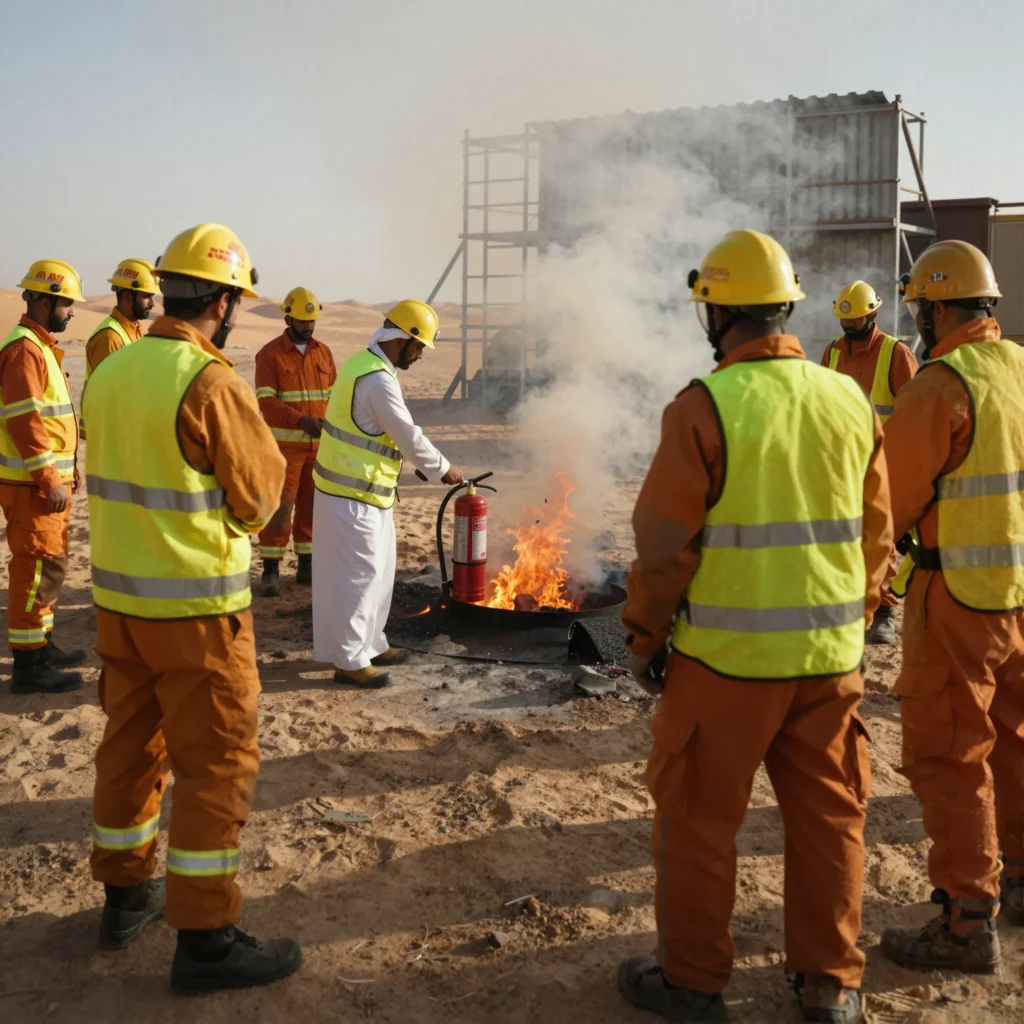
Our Fire Warden Training course is a deep dive into practical competency:
Module 1: Fire Science & Behavior
The Fire Triangle: Understanding fuel, heat, and oxygen—and how removal of any one element stops a fire.
How Fire Spreads: Convection, conduction, and radiation, with examples relevant to office environments (e.g., through ceilings, ductwork).
Classification of Fires: A, B, C, D, K, and F—and why using the wrong extinguisher can be catastrophic.
Module 2: Fire Risk Identification in Offices
Common Office Hazards: Overloaded electrical sockets, faulty equipment, improper storage, kitchen appliances, and smoking areas.
Special Saudi Considerations: HVAC systems in sealed buildings, effects of extreme heat on electrical loads, maintenance of generators and fuel stores.
Module 3: Hands-On Fire Extinguisher Training
The PASS Technique: We don’t just explain it; every participant practices Pull, Aim, Squeeze, and Sweep using live training extinguishers on controlled fires.
Decision Making: “Fight or Flight?” We train wardens to assess in seconds whether a fire is small and contained enough to tackle safely, or if immediate evacuation is the only option.
Module 4: Roles, Responsibilities & Communication
Chain of command during an emergency.
Effective communication techniques under stress, including dealing with reluctant or panicked individuals.
Assisting persons with disabilities—a critical and often overlooked component.
Module 5: Integration with the Emergency Evacuation Plan
How the warden’s specific duties dovetail with the overall Emergency Evacuation Plan for Offices.
Practicing with floor plans and warden checklists.
“Before Global Arab’s Fire Warden Training, I saw my title as an extra duty on paper,” says Sarah Al-Mansour, an office manager in a Riyadh tower. “The training made it real. Practicing with fire extinguishers, running through scenarios for our specific floor plan—it gave me confidence. I now know exactly what to do, and my team knows to look to me for direction. It’s a serious responsibility, but one I feel prepared for.”
An Emergency Evacuation Plan for Offices is not a document to be filed away. It is a living, breathing blueprint that every employee must understand. A good plan is simple, clear, and practiced regularly. At Global Arab, we help companies develop plans that are compliant with Saudi Civil Defense requirements and, more importantly, actually work in a real emergency.
1. Clear Chain of Command & Warden Structure
Identifies Chief Wardens, Floor Wardens, and deputies by name.
Includes contact information and clearly maps their zones of responsibility on office floor plans.
2. Site-Specific Evacuation Maps & Routes
Primary and Secondary Routes: Clearly marked on maps posted throughout the office, considering different fire locations.
Assembly Points: Designated safe areas outside and away from the building. We advise on selecting appropriate locations in congested urban areas like Jeddah or Khobar.
Accounting for All Personnel: A reliable system for wardens to report headcounts at assembly points.
3. Procedures for Different Scenarios
Full Evacuation: When to order it and how to execute it.
Partial/Staged Evacuation: Relevant for large complexes or high-rises where total evacuation may not be immediately necessary.
Shelter-in-Place: For external threats where exiting is dangerous (e.g., major chemical release in an industrial area like Jubail).
4. Special Assistance Protocols
A dedicated plan for evacuating persons with mobility impairments, including the use of Evacuation Chairs and designated “buddies” or helpers.
Plans for visitors and contractors who are unfamiliar with the building.
5. Communication Protocols
How the alarm will be raised (auto-detection, manual call points).
How instructions will be communicated (PA system, warden voice, text alerts).
Language considerations for multilingual staff.
6. Links to Emergency Services
Clear instructions for contacting Saudi Civil Defense (998).
Information to provide: exact address (including district, which is crucial in large cities like Riyadh), floor, nature of emergency, and any hazards.
We believe a one-size-fits-all plan is a dangerous plan. Our consultants follow a systematic approach:
Step 1: On-Site Risk Assessment & Walkthrough
Our experts visit your office in Jeddah, Riyadh, Dammam, Jubail, or Khobar to:
Identify all fire hazards and potential ignition sources.
Evaluate structural fire protection (doors, compartments).
Assess the adequacy of exits, stairs, and assembly areas.
Understand your specific workforce profile and shift patterns.
Step 2: Plan Development & Documentation
We create a customized Emergency Evacuation Plan for Offices that includes:
Easy-to-understand textual procedures.
Professionally drafted, site-specific floor plan maps.
All necessary appendices (warden lists, equipment locations, contact lists).
Step 3: Integration with Fire Warden Training
We train your designated wardens using the actual plan developed for your office, so they are fully familiar with their specific routes, zones, and responsibilities.
Step 4: Drill Design & Evaluation
We help you design and conduct realistic fire drills, then evaluate performance to identify gaps and areas for improvement in both the plan and the warden team.
“The generic plan we downloaded online was worthless for our unique L-shaped office floor in Dammam,” explains Khalid Al-Otaibi, an operations director. “Global Arab came in, walked the space, and created a plan with two clear primary routes that avoided a potential bottleneck we hadn’t even seen. Their Fire Warden Training then used our actual new floor plans. The first drill we ran after their work was smoother and faster than any we’d done before.”
A great plan considers local context. Here’s how we tailor approaches for different Saudi business hubs:
For High-Rise Offices in Riyadh:
Training emphasizes phased or staged evacuation procedures common in tall buildings.
Plans include designated refuge areas on certain floors for persons with disabilities awaiting assisted evacuation.
Coordination with building management’s overall security and safety team is critical.
For Offices in Industrial Areas (Jubail, Yanbu):
Fire Warden Training includes awareness of specific industrial hazards that could impact the office block (e.g., chemical releases, vapor cloud risks).
Evacuation plans may include shelter-in-place protocols if the threat is external, with guidance on sealing windows and turning off ventilation.
Assembly points must be carefully chosen upwind of potential industrial hazard sources.
For Mixed-Use Complexes in Jeddah & Khobar:
Plans must account for public access areas, retail spaces, and multiple tenant operations within one building.
Wardens need training on managing public visitors during an evacuation.
Coordination with complex management for building-wide alarm systems and drills is essential.
For Older or Heritage Buildings:
Risk assessments pay special attention to electrical systems and available escape routes, which may be narrower or fewer than in modern buildings.
Evacuation strategies might prioritize speed due to potentially less robust fire compartmentalization.
Beyond the moral imperative, there is a compelling financial and operational case:
1. Regulatory Compliance & Avoidance of Penalties: Saudi Civil Defense conducts inspections. Non-compliance with fire safety and evacuation planning requirements can result in significant fines and operational shutdowns.
2. Protection of Human Capital: Your employees are your greatest asset. Protecting them is fundamental to business continuity and corporate reputation.
3. Reduction of Property Loss: A quick, effective response by trained wardens can contain a small fire, preventing catastrophic loss of premises, equipment, and data.
4. Insurance Benefits: Many insurers offer reduced premiums for businesses that can demonstrate robust fire safety programs, including trained personnel and practiced plans.
5. Enhanced Corporate Reputation: Clients, partners, and investors see a commitment to safety as a marker of professional, responsible management
“We viewed fire safety training as a cost. Global Arab helped us reframe it as an investment in resilience,” says the CEO of a tech firm in Riyadh. “After completing their Fire Warden Training and implementing their Emergency Evacuation Plan for Offices, our staff feel safer, our insurance advisor was impressed, and we passed a Civil Defense inspection with commendation. The peace of mind alone is worth it.”
We deliver internationally recognized safety training and professional inspection solutions.
From workplace safety to equipment compliance, our certified experts ensure quality and trust.
Serving Saudi Arabia and the Gulf region with global standards.
Your safety, knowledge, and success are our priority.
