Home / First Aid Training
Imagine this scenario in your Saudi workplace: a colleague suddenly collapses. They’re not breathing. What is your next move? Who do you call, and how do you act in the critical minutes before professional help arrives? This is precisely where First Aid Training in Saudi Arabia shifts from being a valuable asset to a potentially life-saving necessity.
At Global Arab, we have witnessed firsthand the transformative power of certified First Aid Training in Saudi Arabia. From the high-rise construction sites of Riyadh to the corporate offices of Jeddah, equipping your team with these essential skills does more than create a safer environment—it forges a crucial line of defense where minutes can mean the difference between life and death.
In this comprehensive guide, we will explore the vital components of first aid training, from fundamental life-saving techniques to the advanced certifications that meet Saudi compliance standards. Whether you are an employer aiming to protect your workforce or an individual seeking to build essential skills, this resource is designed to provide the critical knowledge you need to make an informed, life-saving decision.
At Global Arab, we’ve seen firsthand how proper first aid training transforms workplaces across Saudi Arabia. From construction sites in Riyadh to corporate offices in Jeddah, having employees trained in first aid creates safer environments and can mean the difference between life and death.
In this comprehensive guide, we’ll explore everything you need to know about first aid training—from basic techniques to advanced certifications. Whether you’re an employer looking to train your team or an individual seeking to learn life-saving skills, this article will provide the essential information you need.
First aid refers to the immediate assistance provided to any person suffering from either a minor or serious illness or injury. The primary goals are simple yet crucial:
Preserve life
Prevent the condition from worsening
Promote recovery
At Global Arab, our first aid courses begin with these fundamental principles. We believe that everyone—from office workers to industrial employees—should have basic first aid knowledge.
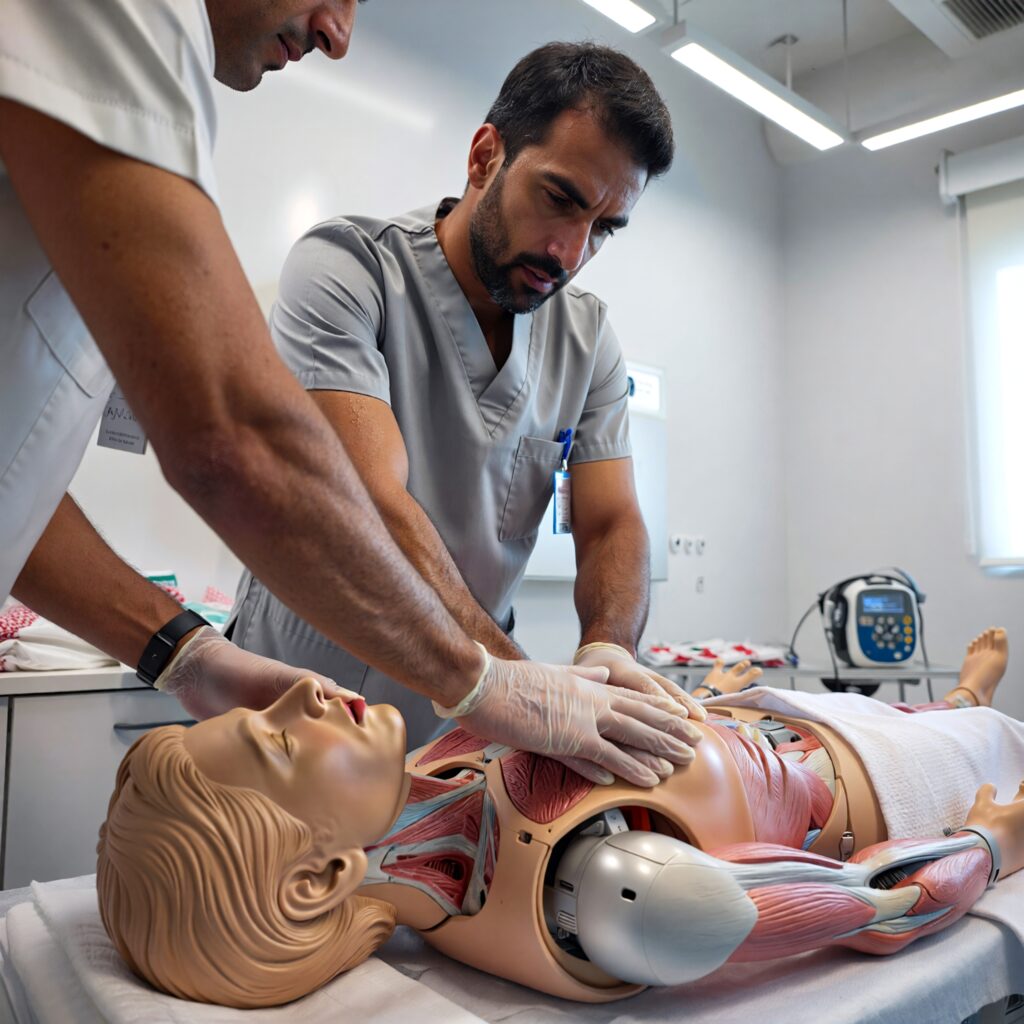
The most advanced first aid technique is useless if panic freezes you. Before you learn CPR or how to use an AED, you need to cultivate the First Aid Mindset—the mental readiness to act when seconds count.
This mindset isn’t about being fearless; it’s about having a plan for your own fear. It’s built on three pillars we emphasize in every First Aid Training Saudi Arabia course:
1. The “SEE-Assess-Act” Loop (Replace Panic with Procedure):
When you encounter an emergency, your brain needs simple steps.
SEE: Pause for 2 seconds. Scan the scene. Is it safe for you? (e.g., live wires, traffic, fire).
ASSESS: Kneel down. Check for a response. “Hey, hey, are you okay?” Look for normal breathing.
ACT: Based on your assessment, begin the appropriate action—call for help, start CPR, control bleeding.
This loop turns overwhelming chaos into a manageable checklist.
2. Permission to Be “Good Enough”:
In a cardiac emergency, research shows that any attempt at CPR is better than no attempt. You might worry about breaking a rib or doing it imperfectly. The First Aid Mindset gives you permission to act with the knowledge you have. Your action, even if imperfect, is a lifeline.
3. Know Your One Job: Bridge the Gap.
Your role as a first aider is not to be a doctor. It is to be the critical bridge between the moment of crisis and the arrival of professional medical help (like Saudi Red Crescent). Your job is to preserve life and prevent the situation from getting worse. This clear, achievable goal removes the pressure to “fix” everything.
At Global Arab, we train this mindset through realistic simulations. We don’t just teach you what to do; we train you to think and react under stress, ensuring you can translate your skills from the calm classroom to a chaotic real-world moment in Riyadh or Jeddah.
You’ve completed your First Aid Training Saudi Arabia. You know the techniques. But when a real emergency happens, will you act? Research shows that even trained individuals can experience “psychological paralysis”—a freeze response that overrides their knowledge.
Understanding why this happens—and how to overcome it—is as important as learning CPR itself.
Why We Freeze: The Three Fs of Emergency Response
Human beings respond to threats through an ancient neurological pathway: Fight, Flight, or Freeze. In medical emergencies, freezing is surprisingly common. Here’s why:
The Fear of Doing Harm: “What if I break a rib during CPR?” “What if I make it worse?” This fear is powerful, but the reality is clear: in a cardiac emergency, the person is already clinically dead. You cannot make it worse. Any action is better than no action.
The Bystander Effect: In a group, individuals often assume someone else will act. Everyone waits, and no one acts. The solution? Point directly at one person and give a clear command: “You in the blue shirt, call 911. YOU.”
Ambiguity: If you’re unsure whether someone is having a heart attack or just fainted, you may hesitate. Our First Aid Training Saudi Arabia replaces ambiguity with a clear assessment protocol: check for response, check for breathing, then act
How to Train Your Brain to Override the Freeze Response
1. Mental Rehearsal:
Studies show that visualizing an emergency response activates the same neural pathways as physical practice. Before your training, before a shift, take 60 seconds to close your eyes and mentally walk through: “If someone collapses, I will check the scene, check for response, call for help, and begin CPR.” This primes your brain to act.
2. Anchor to a Simple Mantra:
Create a short, repeatable phrase that cuts through panic. At Global Arab, we teach: “Check, Call, Care.” Check the scene and the person. Call for emergency help. Care for the victim. In moments of stress, having a simple anchor prevents freezing.
3. Practice “Low-Stakes” Leadership:
Build your emergency response confidence by volunteering to lead in lower-pressure situations. Lead a safety meeting. Volunteer to check first aid kits. These small acts build the neural pathways for taking initiative—pathways that activate in real emergencies.
4. Debrief After Every Response:
After any real first aid incident—even a minor one—take five minutes to debrief with your team. What went well? What would you do differently? This normalizes emergency response and builds collective competence.
The Global Arab Advantage:
Our First Aid Training Saudi Arabia programs include psychological preparedness alongside physical skills. We don’t just teach you what to do; we train you to override hesitation, trust your training, and become the calm, competent responder your team needs. Because in the critical first minutes, the person who acts isn’t necessarily the most skilled—they’re the one who has prepared their mind as well as their hands.
Saudi Arabia’s rapid industrial and economic growth brings increased responsibility for workplace safety. The Saudi Civil Defense and Ministry of Health have specific requirements for first aid preparedness in workplaces. Our training programs at Global Arab ensure you not only meet these legal requirements but exceed them.
Real Impact Story: Last year, a manufacturing plant in Dammam that had completed our first aid certification program successfully handled a cardiac emergency. Their quick response using CPR and an AED saved an employee’s life. This is why we do what we do.
In our years of providing First Aid Training Saudi Arabia, we’ve noticed a pattern: the most serious incidents are often preceded by a small, overlooked problem. The biggest risk isn’t always the hazard itself—it’s the assumption that downplays it.
Let’s confront the five most dangerous assumptions we hear:
1. “It’s just a small cut. It’ll stop on its own.”
The Dangerous Truth: A “small cut” from unclean equipment can lead to a severe infection like sepsis. Proper cleaning and dressing in your Saudi workplace first aid kit are non-negotiable.
2. “They just fainted. They need to sleep it off.”
The Dangerous Truth: Fainting can be a sign of a heart condition, diabetic emergency, or heat stroke—especially in our climate. Laying them flat and elevating their legs is the first step; knowing when to call for an ambulance is the critical second step we teach.
3. “The ambulance is on its way. Our job is done.”
The Dangerous Truth: The average ambulance response time in a major Saudi city is 8-12 minutes. For a cardiac arrest, brain damage begins at 4 minutes. Those minutes in between are everything. This is why CPR and AED training form the core of our courses.
4. “We have a first aid kit in the manager’s office.”
The Dangerous Truth: A kit is useless if it’s locked away, outdated, or no one knows how to use its contents. We train teams not only on skills but on how to audit and maintain their kits to Saudi Red Crescent standards.
5. “First aid is for accidents. Medical emergencies are different.”
The Dangerous Truth: A heart attack or a severe allergic reaction is a medical emergency, but the first aid response—call for help, begin CPR, use an EpiPen—is what bridges the gap to professional care. This mindset saves lives.
The Global Arab Pledge: Our training is designed to shatter these assumptions. We replace hesitation with knowledge, and panic with a calm, step-by-step competence that works within the reality of Saudi workplaces.
We hear them all the time. While the value of first aid seems obvious, hesitation persists. Let’s address the top five excuses head-on and reveal the critical risks hidden behind each one.
Excuse #1: “It’s too expensive for our budget.”
The Reality: Compare the one-time cost of training your team to the potential financial devastation of a single serious incident. Calculate the costs of work stoppages, regulatory fines from Saudi Civil Defense, increased insurance premiums, and potential lawsuits. The training is not an expense; it’s your most cost-effective insurance policy.
Excuse #2: “We don’t have time for our staff to be away for training.”
The Reality: How much time is lost to a full-site evacuation, a lengthy investigation, or the morale drop after a traumatic incident? A one-day course prevents weeks or months of disruption. We offer flexible scheduling, on-site training, and even blended courses to minimize operational impact.
Excuse #3: “It’s not really needed in our type of office/ low-risk environment.”
The Dangerous Truth: Medical emergencies don’t check your industry. Cardiac arrests, choking incidents, and severe allergic reactions can happen anywhere, at any time. In fact, in “low-risk” environments, the surprise and lack of preparedness can make the outcome worse.
Excuse #4: “We have a first aid kit; that’s enough.”
The Critical Gap: A kit is just a box of tools. Without trained personnel, it’s useless. Imagine handing someone a defibrillator with no idea how to use it. Training turns equipment into life-saving action.
Excuse #5: “Someone else will call for help / handle it.”
The Bystander Effect: This is the most dangerous assumption of all. In an emergency, panic sets in, and people freeze. Without a designated, trained responder, critical minutes are lost. Certification designates who acts, eliminating hesitation and directly saving lives.
The Global Arab Pledge:
We don’t just train; we empower. Our First Aid Training Saudi Arabia courses are designed to dismantle these excuses by providing affordable, flexible, and context-aware programs that fit your Saudi workplace. We give you more than skills; we give you the peace of mind that when seconds count, your team won’t stand by—they will step up.
Our most popular course covers essential skills everyone should know:
Assessing emergency situations safely
Performing CPR on adults, children, and infants
Using Automated External Defibrillators (AEDs)
Treating burns, cuts, and fractures
Managing choking emergencies
Course Duration: 1 day (8 hours)
Certification Valid: 2 years
Specifically designed for Saudi workplaces, this course includes:
Emergency response planning
Multiple casualty management
Workplace-specific hazard identification
First aid kit requirements for Saudi regulations
For safety professionals and emergency response teams:
Advanced airway management
Oxygen administration
Spinal injury management
Extended emergency care
Industrial First Aid: For construction, oil and gas, and manufacturing sectors
Pediatric First Aid: For schools and childcare facilities
Sports First Aid: For fitness centers and sports facilities
CPR is perhaps the most crucial first aid skill. Our training covers:
Recognizing cardiac arrest
Proper hand placement and compression depth
Rescue breathing techniques
Using barrier devices
Remember: Early CPR can double or triple chances of survival after cardiac arrest.
AEDs are increasingly available in Saudi workplaces. Our training includes:
Safe operation of AED devices
Pad placement
Following voice prompts
Safety considerations
Proper wound care prevents infection and promotes healing:
Direct pressure techniques
Cleaning and dressing wounds
Recognizing signs of serious bleeding
When to seek professional medical help
From minor kitchen burns to serious industrial injuries:
Assessing burn severity
Cooling techniques
Appropriate covering materials
When to seek emergency care
Immobilization techniques for:
Suspected fractures
Sprains and strains
Spinal injuries
Head injuries
A construction site in Dammam or a compound in Riyadh is a mosaic of languages and cultures. In an emergency, a language barrier can be as dangerous as a missing first aid kit. Effective First Aid Training Saudi Arabia must prepare you for this reality.
Strategies for Clear Communication Under Stress:
1. Universal Visual Commands:
Words may fail, but gestures are universal. We drill simple, non-verbal commands:
Point directly at a person, make eye contact, and point to the phone: “YOU, CALL 911.”
Use a sweeping hand motion towards an exit: “EVERYONE, MOVE HERE.”
Demonstrate the action yourself (e.g., miming chest compressions).
2. The “Buddy & Interpreter” System:
Identify team members who share languages before an emergency happens. In your safety briefing, establish: “If there’s an emergency and Ali needs help, Hassan will translate.” This pre-planning is crucial.
3. Multilingual First Aid Kits & Signage:
Go beyond Arabic and English. Use simple pictograms and key first aid terms in the most common languages on your site (e.g., Urdu, Bengali, Tagalog) on kit labels and emergency posters.
4. Culturally Sensible Care:
Understanding small cultural nuances builds trust and improves care. For example, knowing how to appropriately assess or treat a female colleague while respecting cultural norms can ensure they accept vital help without delay.
The Global Arab Advantage:
Our training is built for the Saudi workforce. Our instructors have firsthand experience delivering first aid in multilingual environments. We incorporate communication drills and scenario planning specific to the demographics of your industry, ensuring your team’s first aid plan works for everyone on site. This isn’t just training; it’s building a truly inclusive and effective safety net.
While core first aid principles are universal, the most effective training addresses the specific risks of your workplace. Saudi Arabia’s diverse economy demands specialized preparedness. Here’s how our First Aid Training Saudi Arabia programs are customized for major local industries:
For Construction & Mega-Projects (NEOM, Red Sea, Qiddiya):
Focus Areas: Trauma response, crush injuries, fall-related injuries, heat illness, and managing incidents in remote or high-rise locations.
Our Added Value: Training includes scenario drills for construction sites and aligns with Saudi Aramco contractor safety management expectations.
For Oil, Gas & Petrochemicals:
Focus Areas: Chemical exposure/burns, H2S awareness linked to first response, confined space emergency protocols, and major incident first aid triage.
Our Added Value: Integration with common site safety protocols and focus on rapid extraction and decontamination procedures.
For Schools, Universities & Childcare Facilities:
Focus Areas: Pediatric CPR & choking, asthma/anaphylaxis management, head injuries, and managing childhood illnesses in a care setting.
Our Added Value: Courses meet the specific requirements of the Saudi Ministry of Education and train staff to calm and communicate effectively with children.
For Corporate Offices & Hospitality:
Focus Areas: Sudden cardiac arrest (AED use), managing common office injuries, responding to guest medical emergencies, and food-related choking.
Our Added Value: Emphasis on professional communication, using first aid kits commonly found in these settings, and creating emergency action plans for high-occupancy buildings.
The Global Arab Advantage: We don’t believe in a one-size-fits-all approach. By choosing a program tailored to your sector, you ensure your team trains for the emergencies they are most likely to face, making their skills sharper, faster, and more effective. This targeted preparedness is what defines best-in-class First Aid Training Saudi Arabia.
While CPR and AED training prepare you for the worst-case scenario, the reality is that most workplace first aid involves responding to common, everyday injuries. Proper management of these “minor” incidents prevents them from becoming major problems, reduces lost work time, and demonstrates a genuine culture of care.
Our First Aid Training Saudi Arabia programs place a strong emphasis on these essential, frequently-used skills:
Effective Management of Sprains, Strains, and Musculoskeletal Injuries: Learn the correct RICE protocol (Rest, Ice, Compression, Elevation) and how to identify when an injury needs an X-ray, which is crucial in active industries like construction and logistics.
Recognizing and Responding to Heat-Related Illnesses: Given Saudi Arabia’s climate, this is a critical local skill. We train your team to distinguish between heat exhaustion (which can be treated on-site) and heat stroke (a true medical emergency requiring immediate hospital transfer).
First Aid for Minor Burns and Cuts: Go beyond basics. We teach proper wound cleaning techniques to prevent infection, the latest guidelines on antibiotic ointments, and how to recognize signs that a “minor” cut or burn is becoming serious.
Eye Injury Protocols: From chemical splashes in labs to dust and particulates on industrial sites, we cover safe irrigation techniques and the vital “do not rub” principle to prevent further damage.
The Global Arab Advantage: By mastering these “everyday” skills, your employees become proactive guardians of workplace safety. They can intervene correctly at the first sign of trouble, which is the ultimate goal of any effective First Aid Training Saudi Arabia program—to create a safer, more responsive, and more caring work environment for everyone.
When lives are on the line, choosing a first aid training provider is one of the most critical safety decisions a company can make. With so many options in the market, how do you ensure you’re partnering with a provider that offers genuine competency, not just a paper certificate?
Use this 5-point checklist to evaluate any First Aid Training Saudi Arabia provider before you commit:
Verify Saudi-Specific Compliance: Does the curriculum explicitly cover the requirements of Saudi Red Crescent Authority (SRCA), Ministry of Health, and Saudi Civil Defense? A generic international course may not meet local legal obligations for your workplace.
Scrutinize Instructor Credentials: Are the trainers active medical or emergency response professionals with experience in the Saudi context? There’s a vast difference between a teacher who has read the manual and one who has applied these skills in real situations, whether on a Riyadh construction site or in a Jeddah industrial plant.
Assess the “Hands-On” Ratio: First aid is a practical skill. Ask what percentage of the course is dedicated to realistic, hands-on practice with manikins, AED trainers, and bandages—not just watching slides. At Global Arab, we believe in learning by doing.
Evaluate Post-Course Support: What happens after the certificate is issued? Do they help with compliance documentation, offer refresher alerts, or provide resources for your workplace first aid program? The right partner supports your long-term safety culture.5
Check for Specialization: Does the provider offer courses tailored for your industry’s unique risks? The first aid needs of an office, a school, an oil & gas facility, or a construction site are fundamentally different.
Why This Checklist Matters: Following these criteria ensures your investment actually builds a capable team, not just a compliant one. It’s the difference between staff who panic in an emergency and those who confidently save a life. At Global Arab, we welcome this level of scrutiny because our programs are built to excel in every single area.
When it comes to First Aid Training Saudi Arabia has specific certification requirements that businesses and individuals must understand. Proper certification isn’t just about having a card—it’s about ensuring your training meets Saudi standards and protects your organization legally.
At Global Arab, we guide companies through the complex landscape of first aid certification, ensuring every certificate we issue carries the proper accreditation and meets Saudi regulatory requirements.
Basic First Aid Certification
Covers essential life-saving skills
Required for general workforce
Valid for 2 years
Includes CPR and AED training
Advanced First Aid Certification
Comprehensive emergency care training
Required for safety officers and supervisors
Includes advanced airway management
Valid for 2 years with annual refreshers recommended
Industry-Specific Certifications
Construction first aid certification
Oil and gas emergency response
Pediatric first aid for educational institutions
Sports first aid for fitness facilities
The SRCA sets the benchmark for first aid training in the Kingdom:
Approved Training Content
Minimum training hours requirements
Specific skills demonstration
Practical assessment standards
Theoretical knowledge testing
Certification Recognition
SRCA-approved certificates are recognized nationwide
Required for certain high-risk industries
Must be renewed before expiration
Include both Arabic and English documentation
Healthcare Facility Standards
Higher certification levels for medical staff
Specific infection control protocols
Regular competency assessments
Specialized equipment training
Public Health Guidelines
Community first aid standards
School and university requirements
Public event safety protocols
Disaster response preparedness
Basic Certifications: 2 years
Advanced Certifications: 2 years
Specialized Certifications: 1-3 years depending on industry
Before Expiration
Renewal should begin 90 days before expiry
Refresher course completion
Skills reassessment
Updated regulatory knowledge
Grace Periods
Most certificates have 30-day grace period
After grace period, full retraining may be required
Documentation must be maintained during transitions
We make certification renewal simple and efficient:
Automated Reminders
90-day advance notification
30-day follow-up reminders
Final expiration alerts
Customized scheduling options
Streamlined Renewal Training
Shorter duration than initial certification
Focus on skill updates and changes
Flexible scheduling options
Competitive renewal pricing
Saudi Aramco Requirements
Specific first aid certification levels
Regular refresher training
Site-specific emergency response
Multiple language capabilities
Ministry of Municipal and Rural Affairs Standards
Minimum trained personnel per site
Equipment requirements
Documentation standards
Inspection compliance
Advanced Requirements
Hydrogen sulfide (H2S) awareness
Confined space rescue training
Burn management specialization
Multiple casualty incident response
Offshore Facilities
Additional maritime first aid
Helicopter evacuation procedures
Extended care capabilities
Remote location response
Basic Compliance
Minimum one trained first aider per floor
Basic first aid kit requirements
Emergency response planning
Annual drill participation
Enhanced Standards
Multiple trained personnel
Advanced equipment training
Business continuity integration
Management-level certification
Basic First Aid Certification
Training materials and equipment
Instructor fees and facility costs
Certification processing
Ongoing support services
Advanced Certification Programs
Specialized equipment training
Extended training duration
Higher instructor qualifications
Comprehensive assessment
Group Training Discounts
Reduced per-person rates for groups
On-site training efficiency
Customized scheduling benefits
Long-term partnership discounts
Package Deals
Multiple certification combinations
Annual training contracts
Corporate partnership programs
Volume-based pricing
Instructor Qualifications
Minimum experience requirements
Regular instructor updates
Teaching methodology standards
Practical experience verification
Course Content Updates
Annual curriculum review
Regulatory change integration
Best practice incorporation
Technology and equipment updates
Practical Skills Testing
Hands-on demonstration requirements
Scenario-based assessments
Time-sensitive skill execution
Professional standard adherence
Theoretical Knowledge
Written examination standards
Verbal questioning techniques
Problem-solving assessments
Comprehension verification
Lost Certificates
Quick replacement process
Digital backup systems
Verification services
Employer confirmation letters
Expired Certifications
Accelerated renewal options
Bridging programs
Competency assessments
Flexible scheduling solutions
Under-Trained Workforce
Rapid certification programs
Phased training approaches
Temporary certification solutions
Compliance planning assistance
Regulatory Changes
Update training sessions
Compliance advisory services
Documentation updates
Staff re-orientation programs
Wide Industry Acceptance
Recognized by major Saudi companies
Accepted by regulatory authorities
Trusted by international partners
Preferred by safety professionals
Quality Reputation
High first-time pass rates
Excellent participant feedback
Strong industry relationships
Proven track record of compliance
Documentation Management
Digital certificate storage
Expiration tracking
Bulk certificate processing
Verification services
Compliance Advisory
Regulatory change updates
Audit preparation assistance
Documentation reviews
Best practice recommendations
E-Certificates
Secure digital credentials
Instant verification capabilities
Mobile-friendly formats
Integration with HR systems
Online Learning Components
Blended certification programs
Digital theory assessments
Virtual reality skill practice
Remote proctoring options
Increased Requirements
More frequent recertification
Higher skill standards
Additional specialization
Stricter assessment criteria
International Alignment
Closer alignment with global standards
Mutual recognition agreements
International accreditation
Cross-border certification
Saudi labor laws mandate first aid provisions based on workplace risk levels and employee numbers. Global Arab helps companies understand and implement:
Required first aid kit contents
Minimum number of trained personnel
Documentation and record-keeping
Regular refresher training schedules
Different industries have varying requirements:
Construction: Advanced first aid kits and multiple trained personnel
Offices: Basic first aid supplies and at least one trained first aider
Manufacturing: Comprehensive first aid stations and emergency response teams
Schools: Pediatric first aid specialists
First aid training is more than a compliance requirement—it’s an investment in human life. The skills learned in a Global Arab first aid course empower individuals to take action when seconds count. Whether responding to a minor injury or a life-threatening emergency, trained employees make the difference between chaos and controlled response.
At Global Arab, we’re committed to making Saudi workplaces safer through comprehensive first aid training. Our programs combine international best practices with local expertise, ensuring you receive the highest quality training available.
Ready to start your first aid training journey? Contact Global Arab today to schedule your workplace assessment or enroll in our next public course. Together, we can build a safer, more prepared workforce for Saudi Arabia.
At Global Arab, we begin every corporate training program with a thorough assessment:
Workplace hazard analysis
Employee number and distribution
Existing emergency response capabilities
Specific risk factors
We help identify ideal candidates for first aid training:
Employees from all shifts and departments
Those with natural leadership qualities
Personnel who remain calm under pressure
Volunteers who show genuine interest
Lorem ipsum dolor sit amet, consectetur adipiscing elit. Ut elit tellus, luctus nec ullamcorper mattis, pulvinar dapibus leo.
A comprehensive first aid program requires proper equipment:
Appropriately stocked first aid kits
AED placement in accessible locations
Emergency communication systems
Personal protective equipment
First aid skills degrade over time. We recommend:
Annual skill refreshers
Regular equipment checks
Updated training for new hazards
Practice scenarios and drills
Myth 1: “You should tilt your head back during a nosebleed”
Truth: Lean forward to prevent blood from going down your throat.
Myth 2: “Butter helps burns heal”
Truth: Cool running water for at least 10 minutes is the proper treatment.
Myth 3: “CPR usually revives people”
Truth: CPR maintains blood flow until advanced care arrives—it rarely immediately revives someone.
At Global Arab, we focus on evidence-based first aid practices that align with international standards and local Saudi requirements.
We bring our expert instructors to your location:
Customized to your specific workplace
Flexible scheduling around operations
Hands-on practice with your equipment
Team-building through group learning
Join our regularly scheduled classes across Saudi Arabia:
Network with professionals from other companies
Learn in purpose-built training facilities
Access to advanced training equipment
Multiple language options available
Combine online theory with practical sessions:
Learn at your own pace
Reduce time away from work
Practice skills with instructor guidance
Cost-effective solution for large teams
A Jeddah-based manufacturing company trained 45 employees through Global Arab’s workplace first aid program. Within six months, they successfully managed:
3 serious cut injuries
2 burn incidents
1 cardiac emergency
Multiple minor medical issues
The plant manager reported: “The confidence our team gained through Global Arab’s training transformed our safety culture. Employees now proactively identify hazards and feel empowered to respond to emergencies.”
A Riyadh international school completed our pediatric first aid program. When a student had a severe allergic reaction, staff:
Recognized the symptoms immediately
Administered the epinephrine auto-injector
Managed the situation until paramedics arrived
Potentially saved the student’s life
Behind every statistic is a story. These real accounts from organizations across Saudi Arabia demonstrate the life-saving power of quality First Aid Training Saudi Arabia. Their experiences show that when you invest in preparedness, you’re not just checking a compliance box—you’re building a team ready to act when seconds count.
Case Study 1: Jubail Petrochemical Plant – A Cardiac Emergency Averted
The Setting: A large petrochemical facility in Jubail Industrial City with over 2,500 employees across multiple shifts.
The Training: The company had invested in comprehensive First Aid Training Saudi Arabia for their safety team, including advanced CPR and AED certification for 50 designated responders.
The Incident: During a routine morning shift, a senior engineer collapsed in the control room. Colleagues initially thought he had fainted from the heat, but a trained responder recognized the signs of cardiac arrest: unresponsiveness and abnormal breathing.
The Response: Within 60 seconds, the responder began CPR while another retrieved the AED from the nearby station. The AED analyzed, advised a shock, and delivered it. CPR continued until emergency services arrived 12 minutes later.
Case Study 2: Riyadh Construction Site – A Fall from Height Managed
The Setting: A high-rise construction project in Riyadh’s King Abdullah Financial District, with 800 workers on site daily.
The Training: The construction company had mandated First Aid Training Saudi Arabia for all site supervisors and designated safety champions on every floor.
The Incident: A worker lost his footing on scaffolding, falling approximately 4 meters. He was conscious but in severe pain, with an obviously deformed leg and suspected spinal injury.
The Response: The nearest trained supervisor arrived within 90 seconds. Remembering his training, he:
Directed others to secure the scene and prevent movement of the victim
Called for emergency services with precise location details
Applied manual stabilization to the victim’s head and neck
Controlled bleeding from a leg wound while maintaining spinal precautions
Coordinated with paramedics on arrival for safe extrication
The Outcome: The worker made a full recovery. The site safety manager reported: “Our First Aid Training Saudi Arabia program meant that when the worst happened, we had people who knew exactly what to do. No panic, just procedure. That worker walks today because of it.”
Case Study 3: Jeddah Hotel – A Choking Guest Saved
The Setting: A five-star hotel in Jeddah serving hundreds of international guests daily during peak season.
The Training: The hotel had implemented First Aid Training Saudi Arabia for all front-line staff, with specific emphasis on choking and cardiac emergencies common in hospitality settings.
The Incident: During breakfast service, a guest began choking on a piece of meat. He stood up, clutching his throat, unable to speak or cough. Other guests froze, uncertain what to do.
The Response: A server who had completed training just two months earlier recognized the universal sign of choking. She moved behind the guest, performed abdominal thrusts (Heimlich maneuver), and within three thrusts, the obstruction was dislodged.
The Outcome: The guest was shaken but unharmed. He later wrote a letter to management: “Your employee saved my life. I will never forget the calm, professional way she handled a terrifying situation.”
Case Study 4: Dammam School – An Anaphylactic Reaction Responded To
The Setting: An international school in Dammam with 1,200 students, including several with known severe allergies.
The Training: The school had invested in specialized pediatric First Aid Training Saudi Arabia for all teachers and staff, including epinephrine auto-injector training.
The Incident: During lunch, a student with a known nut allergy accidentally consumed food containing peanut protein. Within minutes, she developed hives, swelling, and difficulty breathing.
The Response: The teacher, trained just six months prior, recognized the signs of anaphylaxis. She immediately:
Sent another student to fetch the school nurse
Administered the student’s prescribed epinephrine auto-injector
Placed the student in a recovery position
Monitored breathing until emergency services arrived
The Outcome: The student fully recovered and returned to school the following week. The school’s principal stated: “Our First Aid Training Saudi Arabia program gave our staff the confidence and skills to act decisively. There is no price tag on that peace of mind.”
Key Lessons from These Stories:
Training Works: In every case, trained individuals acted quickly and correctly.
Confidence Matters: Training builds the confidence to act, not just the knowledge of what to do.
Systems Save Lives: These successes involved not just individuals, but coordinated systems: accessible AEDs, clear communication, and practiced protocols.
Preparation Pays: Every organization that invested in First Aid Training Saudi Arabia saw their investment returned in the most meaningful way possible—a life saved.
A: Most certifications, including Global Arab’s, are valid for two years. We recommend annual refreshers.
A: While theoretical components can be online, practical assessment must be in-person for proper skill verification.
A: This depends on your industry, workplace size, and risk level. We provide specific recommendations during our consultation.
A: Basic covers essential life-saving skills, while advanced includes oxygen administration, advanced airway management, and extended care.
A: Yes! Global Arab offers courses in both Arabic and English, with multilingual instructors available.
Contact Global Arab for a complimentary workplace assessment. We’ll identify your specific requirements and recommend the right training solutions.
We customize training content to address your unique workplace hazards and employee needs.
Our expert instructors deliver engaging, practical training that ensures skill retention.
We provide refresher courses, program updates, and continuous support to maintain your first aid readiness.
When it comes to First Aid Training Saudi Arabia has specific regulations and cultural considerations that make specialized training essential. The Kingdom’s rapid modernization and diverse workforce create unique challenges that require tailored first aid solutions.
At Global Arab, we’ve spent years adapting international first aid standards to meet Saudi Arabia’s specific needs. Our programs blend global best practices with local regulatory requirements, ensuring your organization remains compliant while providing the best possible emergency care.
The Saudi Arabian government has established comprehensive requirements for workplace first aid through multiple regulatory bodies:
Ministry of Human Resources and Social Development (MHRSD)
Mandates first aid training based on workplace risk levels
Requires first aid kits specific to industry types
Specifies minimum number of trained first aiders per shift
Saudi Red Crescent Authority (SRCA)
Sets standards for emergency medical response
Provides guidelines for first aid training content
Oversees some certification programs
Saudi Civil Defense
Establishes requirements for fire-related first aid
Sets standards for emergency evacuation procedures
Mandates first aid training for specific high-risk industries
First Aid Training Saudi Arabia programs must account for the Kingdom’s diverse workforce. At Global Arab, we address these unique challenges through:
Multilingual Training Materials
Course content available in Arabic and English
Visual aids that transcend language barriers
Instructors fluent in multiple languages common in Saudi workplaces
Cultural Sensitivity
Understanding local customs and preferences
Adapting practical scenarios to Saudi contexts
Respecting cultural norms while maintaining training effectiveness
Real-World Saudi Scenarios
Our training incorporates situations specific to Saudi Arabia:
Heat-related illnesses in extreme summer temperatures
Construction site incidents common in Saudi megaprojects
Industrial accidents in oil and gas facilities
Road traffic accidents on Saudi highways
Saudi Arabia’s Occupational Safety and Health standards require specific first aid provisions:
Workplace Risk Classification
Low-risk workplaces (offices, retail): Basic first aid requirements
Medium-risk workplaces (light manufacturing): Enhanced first aid provisions
High-risk workplaces (construction, oil/gas): Comprehensive first aid programs
Required First Aid Personnel
1 trained first aider per 50 employees in low-risk environments
1 trained first aider per 25 employees in medium-risk environments
1 trained first aider per 10 employees in high-risk environments
Additional requirements for remote work sites
Understanding the legal requirement is the first step. The next, crucial decision is selecting a training provider whose certification will be recognized, valued, and truly prepare you or your team. In Saudi Arabia’s diverse training market, not all courses are equal. Here are the five key factors to verify before you enroll.
1. Accreditation & Civil Defense Recognition
This is non-negotiable. The provider must offer certificates that are officially accredited and recognized by the Saudi Civil Defense and relevant Saudi authorities. This ensures your certification is valid for compliance audits, facility licensing, and employer requirements.
Why GlobalArab is the Right Choice: Our First Aid, CPR, and Basic Life Support (BLS) courses are designed to meet and exceed the standards set by the Saudi Civil Defense. We provide certificates that are widely accepted for compliance across all major industries in the Kingdom.
2. Trainer Expertise & Real-World Experience
First aid is a practical skill. Instructors should be certified master trainers with real-world experience, preferably in Saudi industrial, medical, or corporate settings. They should be able to translate theory into actionable knowledge for local scenarios.
The GlobalArab Advantage: Our trainers are seasoned professionals with backgrounds in emergency medical services, industrial safety, and healthcare. They don’t just teach the manual; they share critical insights from responding to real incidents in the GCC region.
3. Course Content Tailored for the Saudi Context
The training must cover emergencies prevalent in Saudi Arabia, such as heat stroke, cardiac incidents, traffic accident response, and workplace-specific injuries common in construction, oil & gas, and hospitality.
How Our Curriculum Stands Out: Beyond global standards, our curriculum integrates modules specifically relevant to the KSA environment and workforce. We ensure you learn to handle the emergencies you are most likely to face here.
4. Emphasis on Hands-On, Practical Skills
A quality course should dedicate over 50% of its time to hands-on practice. Look for a provider that uses modern equipment like advanced CPR manikins, AED trainers, and sufficient bandaging materials for all participants.
Our Practical Approach: At GlobalArab, our training is hands-on from start to finish. We maintain a low instructor-to-student ratio to ensure every participant gets ample time to practice and master life-saving techniques like chest compressions, recovery position, and using an AED.
5. Language & Cultural Accessibility
Training must be effective for your entire workforce. The provider should offer instruction in both Arabic and English, with an understanding of the cultural dynamics of a multicultural workplace.
Our Inclusive Training Model: We offer flexible training in Arabic, English, or a bilingual format to ensure clear comprehension for all employees. Our approach respects cultural nuances, ensuring everyone is engaged and confident to act in an emergency.
We’ve developed specialized first aid courses addressing Saudi Arabia’s unique needs:
Heat Illness Prevention and Treatment
Given Saudi Arabia’s extreme climate, we emphasize:
Recognizing heat exhaustion and heat stroke
Proper hydration strategies
Acclimatization procedures for new workers
Emergency cooling techniques
Desert Environment First Aid
Specific training for:
Sandstorm-related injuries
Desert wildlife encounters
Navigation and survival basics
Sun protection and eye safety
Industrial First Aid for Saudi Sectors
Tailored programs for:
Oil and gas industry emergencies
Construction site incidents
Manufacturing facility accidents
Petrochemical plant emergencies
Global Arab’s certifications are widely accepted by:
Saudi Arabian government authorities
International companies operating in the Kingdom
Local Saudi businesses
Project owners and main contractors
1. Compliance Assessment
We begin by evaluating your specific requirements under Saudi law:
Workplace risk classification
Employee numbers and distribution
Existing first aid capabilities
Regulatory compliance gaps
2. Program Customization
Developing training that matches your:
Industry sector and specific hazards
Workforce demographics and languages
Operational locations across Saudi Arabia
Existing safety culture and procedures
3. Delivery Options Across Saudi Arabia
We provide training throughout the Kingdom:
Riyadh Region: Central province operations
Eastern Province: Dammam, Khobar, Jubail industrial centers
Western Region: Jeddah, Mecca, Medina commercial hubs
Remote Sites: Camp-based training for desert operations
4. Ongoing Compliance Management
We help maintain your first aid readiness through:
Certificate renewal tracking
Regulatory update alerts
Refresher training scheduling
Equipment maintenance reminders
A major construction company working on a Riyadh high-rise project trained 120 workers through our First Aid Training Saudi Arabia program. Results included:
Immediate Impact:
Successful management of 8 serious incidents in first 6 months
100% compliance with Saudi regulatory requirements
Improved safety culture and worker confidence
Long-term Benefits:
45% reduction in lost-time injuries
Improved worker morale and retention
Enhanced reputation with clients and authorities
A manufacturing plant in Jeddah implemented our comprehensive first aid program:
Training Delivered:
Basic first aid for all 350 employees
Advanced first aid for 25 safety team members
Management first aid awareness for supervisors
Measurable Outcomes:
Emergency response time reduced from 8 to 2 minutes
First aid intervention success rate: 94%
Regulatory audit results: 100% compliant
Saudi workplaces typically employ workers from multiple nationalities. Our training addresses:
Language Solutions
Bilingual training materials
Multilingual instructors
Visual learning emphasis
Simple, universal emergency signals
Cultural Integration
Respecting diverse cultural backgrounds
Building team emergency response cohesion
Overcoming communication barriers
Fostering inclusive safety culture
Saudi Arabia’s extreme climate requires specialized first aid approaches:
Heat Stress Management
Recognizing early warning signs
Implementing work-rest cycles
Hydration monitoring procedures
Emergency cooling protocols
Seasonal Considerations
Summer peak temperature protocols
Sandstorm emergency procedures
Ramadan fasting considerations
Seasonal workforce fluctuations
The future of First Aid Training Saudi Arabia includes:
Digital Learning Platforms
Mobile-first training content
Virtual reality simulation
Online certification tracking
Digital first aid manuals
Smart Equipment Integration
AED with real-time monitoring
Smart first aid kits with inventory tracking
Mobile emergency alert systems
Digital incident reporting
Saudi Arabia continues to enhance safety standards:
Increasing first aid training requirements
Stricter certification standards
Enhanced documentation requirements
Regular competency assessments
Before beginning your first aid training journey, consider:
Compliance Requirements
Determine your workplace risk classification
Identify required number of trained first aiders
Review first aid kit requirements
Understand documentation obligations
Organizational Needs
Assess workforce languages and cultures
Identify operational locations and challenges
Evaluate existing safety capabilities
Determine management commitment level
Implementation Planning
Schedule training around operations
Select appropriate course types
Plan for ongoing refresher training
Budget for equipment and training
Local Expertise
Deep understanding of Saudi regulations
Extensive experience across Saudi industries
Network of training locations throughout the Kingdom
Relationships with Saudi regulatory authorities
Quality Assurance
Internationally qualified instructors
Regular program updates and improvements
Comprehensive participant assessment
Continuous feedback and improvement
Proven Track Record
Thousands of participants trained annually
High client retention and satisfaction
Demonstrated safety performance improvements
Industry recognition and awards
Congratulations on completing your First Aid Training Saudi Arabia course! The certificate on your wall is important, but its real-world value depends on what you do next. True preparedness is an ongoing process.
Use this simple checklist in the days and weeks after your training to ensure your skills and compliance don’t fade:
✅ Within 1 Week of Training:
Audit Your Kits: Gather your workplace first aid kits. Check that all items match the minimum requirements for Saudi Arabia. Replace any used or expired items.
Map Your AEDs: If you have Automated External Defibrillators (AEDs), ensure every employee knows their locations. Test the “find me” function if available.
✅ Within 1 Month of Training:
Share the Plan: Brief your entire team—even those not yet trained—on the basic emergency response plan. Who is the designated first aider on each shift? What’s the exact address to give 911?
Schedule a Refresher: Book a 90-minute skills refresher session for your team in 6 months. Muscle memory for CPR fades quickly; short, frequent practice is key.
✅ Ongoing & Annual:
Log Your Incidents: Start a simple log for every first aid incident, even minor ones. This data is gold—it shows patterns and proves your program’s activity to Saudi Civil Defense inspectors.
Renew on Time: Mark your calendar 90 days before your certificates expire. The Saudi Red Crescent Authority does not typically offer a grace period for lapsed certifications.
How Global Arab Supports You: We believe our job isn’t done when the course ends. We provide our clients with digital copies of this checklist, templates for incident logs, and automated reminders for certificate renewal. We’re your partner in building a sustainably safe workplace.
You’ve invested in quality First Aid Training Saudi Arabia. Your team is certified. But here’s the uncomfortable truth most providers won’t tell you: the clock is already ticking on their competence.
Research in medical education shows that basic life support skills begin to decay significantly within 3 to 6 months of training. After just one year, without practice, retention of critical skills like CPR compression depth and rate can drop below 50%. This phenomenon is called the “skills decay curve.”
Why Skills Fade:
Neurological Pruning: The brain actively discards information it doesn’t use regularly.
The “Illusion of Competence”: Passing a course creates confidence, but confidence without practice is dangerous. People overestimate their ability to perform under stress.
Lack of Real-World Drills: Without realistic, repeated scenarios, the mental pathways for emergency response weaken.
How to Flatten the Decay Curve in Your Saudi Workplace:
Implement “Micro-Learning” Refreshers: Don’t wait two years for renewal. Schedule 15-minute skill drills quarterly. Practice one thing: chest compressions only, or how to unpack and use the AED. Short, frequent practice is scientifically proven to build “muscle memory” that lasts.
Use “Mental Rehearsal” Techniques: Have your team visualize responding to an emergency. Walk through the steps in their minds. Studies show mental rehearsal activates the same neural pathways as physical practice, slowing skill decay.
Conduct Unannounced Drills: Move beyond predictable annual drills. Simulate a scenario (with warning to avoid real panic) where the designated first aider is “unavailable.” This tests the system, not just the individual, revealing hidden gaps in your emergency response plan.
The GlobalArab Commitment: We don’t just certify and leave you. We provide access to digital refresher tools, simple drill guides, and a reminder system to help you build a practice schedule that keeps your team’s skills sharp and their confidence rooted in genuine, maintained competence, long after the course ends.
We’ve discussed the financial ROI of training. But how do you measure the success of your First Aid Training Saudi Arabia program in a way that proves its ongoing value to leadership?
The answer lies in moving beyond “number of people trained” to tracking leading and lagging indicators specific to first aid.
Key Performance Indicators (KPIs) for Your First Aid Program:
Leading Indicators (Predictive):
“Confidence Score”: After training, survey your team: “On a scale of 1-5, how confident are you to act in a cardiac emergency?” Track this score over time. A drop signals the need for refreshers before skills decay.
Drill Completion Rate: What percentage of your planned first aid drills were actually completed on schedule? This measures the health of your program’s implementation.
Kit Audit Pass Rate: What percentage of your first aid kits pass a monthly readiness check (fully stocked, unexpired)? This is a simple but powerful metric.
Lagging Indicators (Outcome-Based):
Time-to-Action: In any real incident, track the estimated time from collapse to first CPR/AED shock. A well-trained team will have a faster response time. This is a direct measure of your training’s impact.
Incident Escalation Rate: What percentage of first aid incidents (e.g., a cut, a faint) escalate to requiring professional medical evacuation or hospital transport? A well-prepared team should manage minor incidents effectively, preventing escalation.
First Aid Intervention Success Rate: When a first aid intervention was required (e.g., CPR, bleeding control), was it performed correctly and effectively based on a post-incident review? This is the ultimate measure of competence.
The GlobalArab Advantage: We help you set up these tracking systems. We provide templates for post-incident reviews and simple survey tools to measure confidence. We believe your first aid program should be treated like any other critical business function—measured, managed, and continuously improved. By treating first aid as a measurable KPI, you don’t just protect lives; you build a data-backed case for the ongoing value of your investment in safety.
Ready to enhance your first aid capabilities in Saudi Arabia? Global Arab makes implementation straightforward:
Immediate Actions:
Contact us for a free compliance assessment
Schedule a consultation at your facility
Receive customized training recommendations
Begin training within 2 weeks
Long-term Partnership:
Ongoing regulatory updates
Regular refresher training
Performance monitoring
Continuous improvement planning
Don’t wait for an emergency to reveal gaps in your first aid preparedness. Invest in quality First Aid Training Saudi Arabia today and build a safer, more compliant workplace tomorrow.
Contact Global Arab now to schedule your first aid training assessment and take the first step toward comprehensive workplace safety.
Lorem ipsum dolor sit amet, consectetur adipiscing elit. Ut elit tellus, luctus nec ullamcorper mattis, pulvinar dapibus leo.
Lorem ipsum dolor sit amet, consectetur adipiscing elit. Ut elit tellus, luctus nec ullamcorper mattis, pulvinar dapibus leo.
We deliver internationally recognized safety training and professional inspection solutions.
From workplace safety to equipment compliance, our certified experts ensure quality and trust.
Serving Saudi Arabia and the Gulf region with global standards.
Your safety, knowledge, and success are our priority.
