Home / H2S Training
Hydrogen sulfide (H2S) represents one of the most significant safety concerns across numerous industries in Saudi Arabia, particularly within the oil and gas sector. As the Kingdom continues to expand its industrial capabilities, the demand for comprehensive H2S safety courses has never been more critical. At Global Arab Safety Training, we recognize that proper H2S certification isn’t merely a regulatory requirement—it’s a fundamental component of workplace safety that saves lives daily.
The importance of H2S safety training extends beyond compliance; it empowers workers with the knowledge and skills to identify, monitor, and respond to H2S emergencies effectively. Our H2S safety courses are specifically designed to address the unique challenges faced by Saudi Arabian industries, combining international best practices with local regulatory requirements. Whether you’re working in oil refineries, petrochemical plants, or construction sites, understanding H2S hazards through proper H2S safety training is non-negotiable for ensuring workplace safety.
Hydrogen sulfide (H2S) is a colorless, flammable, extremely hazardous gas with a distinct “rotten egg” odor at low concentrations. However, this characteristic smell can be deceptive—at higher concentrations, H2S rapidly paralyzes the olfactory nerves, making victims unaware of its presence. This is why comprehensive H2S safety courses are essential for anyone working in environments where H2S exposure might occur.
The properties of H2S make it particularly dangerous. It’s heavier than air, which means it accumulates in low-lying areas, confined spaces, and poorly ventilated locations—common scenarios in many industrial settings throughout Saudi Arabia. Through our H2S safety training programs at Global Arab, participants learn not only to recognize the characteristics of H2S but also to understand its behavior in different environments, enabling them to make informed safety decisions.
Saudi Arabia’s rapid industrial growth, particularly in the oil and gas sector, has necessitated stringent safety regulations. The H2S safety courses requirement is embedded in multiple Saudi regulatory frameworks, including those established by the Saudi Arabian Ministry of Energy, Industry and Mineral Resources, and the Saudi Arabian Oil Company (Aramco). These regulations mandate that all personnel working in H2S-prone environments must complete certified H2S safety training and maintain valid H2S certification.
At Global Arab Safety Training, our H2S safety courses exceed these regulatory requirements, providing participants with practical skills that extend beyond classroom knowledge. Our H2S certification programs are recognized across Saudi industries, ensuring that graduates meet the highest standards of H2S safety competence. The comprehensive nature of our H2S safety training means that participants leave not just with a certificate, but with genuine confidence in their ability to handle H2S-related emergencies
Our flagship H2S safety courses at Global Arab are designed to provide participants with thorough understanding and practical skills in H2S safety management. The H2S certification program covers everything from basic awareness to advanced emergency response, ensuring that graduates can confidently navigate H2S-prone environments. The learning objectives of our H2S safety training include:
Understanding the properties and characteristics of H2S
Recognizing potential H2S sources and exposure scenarios
Mastering H2S detection methods and monitoring equipment
Implementing effective H2S safety protocols and procedures
Developing emergency response skills for H2S incidents
Learning proper use of personal protective equipment (PPE) in H2S environments
Understanding rescue procedures for H2S exposure victims
The structured approach of our H2S safety courses ensures that participants develop a comprehensive safety mindset that extends beyond mere compliance. Our H2S safety training emphasizes practical application, with hands-on exercises that simulate real-world scenarios encountered in Saudi industrial settings.
The need for H2S safety training extends across numerous roles and industries within Saudi Arabia. Our H2S safety courses are essential for:
Oil and gas field operators and technicians
Refinery and petrochemical plant workers
Construction personnel working in industrial areas
Safety officers and HSE professionals
Maintenance and facility management staff
Emergency response team members
Contractors working in potentially H2S-contaminated areas
New employees entering H2S-prone industries
The versatility of our H2S certification programs means that we can tailor the H2S safety training to specific industry needs while maintaining the core safety principles that make our H2S safety courses so effective. Whether participants are experienced professionals seeking refresher H2S safety training or newcomers to industries where H2S exposure is possible, our H2S safety courses provide the appropriate level of instruction and practical skill development.
A fundamental component of any effective H2S safety course is understanding the precise levels at which this toxic gas becomes dangerous. At Global Arab, our H2S safety training programs dedicate significant time to ensuring participants can not only recognize the presence of H2S but also interpret concentration levels accurately to make life-saving decisions. The occupational exposure limits for H2S are strictly defined, and our H2S certification ensures workers can navigate these thresholds with confidence.
The most critical levels discussed in our H2S safety courses include the Immediately Dangerous to Life or Health (IDLH) concentration, which for H2S is set at 100 parts per million (ppm). However, even lower concentrations pose significant risks, which is why our H2S safety training emphasizes early detection and proactive monitoring. Participants in our H2S certification programs learn that at concentrations as low as 10-20 ppm, exposure for more than 8 hours requires respiratory protection, while at 100 ppm, immediate evacuation is necessary. This granular understanding of H2S exposure risks forms the bedrock of our comprehensive H2S safety courses at Global Arab, ensuring that graduates don’t just memorize numbers but understand their practical implications in Saudi Arabia’s diverse industrial landscapes.
Modern H2S safety training must encompass hands-on experience with the latest detection technology, and this is where Global Arab’s H2S safety courses excel. We provide participants in our H2S certification programs with practical training on a wide range of detection equipment, from basic portable gas detectors to advanced fixed H2S monitoring systems commonly used across Saudi industrial facilities. This practical component transforms theoretical knowledge into actionable skills, a hallmark of quality H2S safety training.
Our H2S safety courses cover both active and passive detection methods, including:
Portable Personal Gas Detectors: Essential for workers entering potentially hazardous areas, these devices provide continuous monitoring and immediate audible and visual alarms when H2S concentrations reach dangerous levels. Trainees in our H2S certification programs learn proper use, calibration, and maintenance of these critical life-saving devices.
Fixed Gas Detection Systems: Permanently installed in facilities where H2S may be present, these systems provide area monitoring and can trigger ventilation systems or emergency shutdown procedures. Understanding these systems is crucial for our H2S safety training participants who work in control rooms or supervisory roles.
Colorimetric Detector Tubes: These provide immediate spot-check readings for H2S and are valuable for confirming suspected leaks or contamination. While technology has advanced, these simple tools remain part of comprehensive H2S safety courses for their reliability in various conditions.
The hands-on approach to equipment training in Global Arab’s H2S safety courses ensures that graduates of our H2S certification program can confidently operate, troubleshoot, and interpret readings from the same equipment they’ll encounter in Saudi oil fields, refineries, and industrial plants.
Beyond individual detection devices, our advanced H2S safety training at Global Arab teaches participants how to design, implement, and manage comprehensive H2S monitoring programs tailored to specific workplace environments. This strategic approach to H2S safety is what sets our H2S certification apart, producing safety professionals who can develop proactive systems rather than simply react to emergencies.
Key elements covered in this segment of our H2S safety courses include:
Workplace Risk Assessment: Before monitoring begins, our H2S safety training teaches participants to conduct thorough risk assessments identifying potential H2S sources, accumulation areas, and exposure scenarios specific to Saudi industrial operations.
Monitoring Strategy Development: Participants learn to create layered monitoring strategies that combine personal, portable, and fixed detection systems for complete coverage—a critical skill emphasized in our H2S certification curriculum.
Data Interpretation and Response Protocols: Simply detecting H2S isn’t enough; our H2S safety courses train workers to interpret data trends, recognize developing hazardous situations, and implement pre-planned response protocols before emergencies escalate.
Documentation and Compliance: Proper record-keeping for regulatory compliance is integrated throughout our H2S safety training, ensuring Saudi businesses can demonstrate due diligence and adherence to local safety standards.
This comprehensive approach to monitoring within our H2S safety courses ensures that Global Arab graduates bring value to their organizations beyond basic compliance, implementing sophisticated H2S safety management systems that protect both personnel and operations.
The theoretical knowledge covered in our H2S safety courses comes to life through extensive hands-on training sessions at Global Arab’s specialized training facilities. Our H2S certification program includes realistic scenarios using actual H2S detection equipment in controlled environments that simulate real-world conditions encountered across Saudi industries. This practical application is what transforms our H2S safety training from abstract concepts to ingrained competencies.
Participants in our H2S safety courses engage in:
Equipment Calibration Exercises: Proper calibration is fundamental to accurate H2S detection, and our H2S safety training includes hands-on practice with bump testing, calibration procedures, and troubleshooting common equipment issues.
Simulated Leak Detection Drills: Using safe simulation systems, trainees practice locating and assessing H2S leaks in scenarios mimicking oil field operations, refinery units, and confined spaces—common situations addressed in our Saudi-focused H2S certification program.
Alarm Response Training: When H2S monitors alarm, correct immediate response is critical. Our H2S safety courses build muscle memory for proper alarm response through repeated drills under realistic stress conditions.
Monitoring Program Development Workshops: Advanced participants in our H2S safety training collaborate to design monitoring programs for sample facilities, receiving expert feedback from Global Arab’s seasoned instructors.
This emphasis on practical skills ensures that Global Arab’s H2S certification holders don’t just understand H2S detection theoretically but can perform effectively when faced with real H2S challenges in their workplaces across Saudi Arabia.
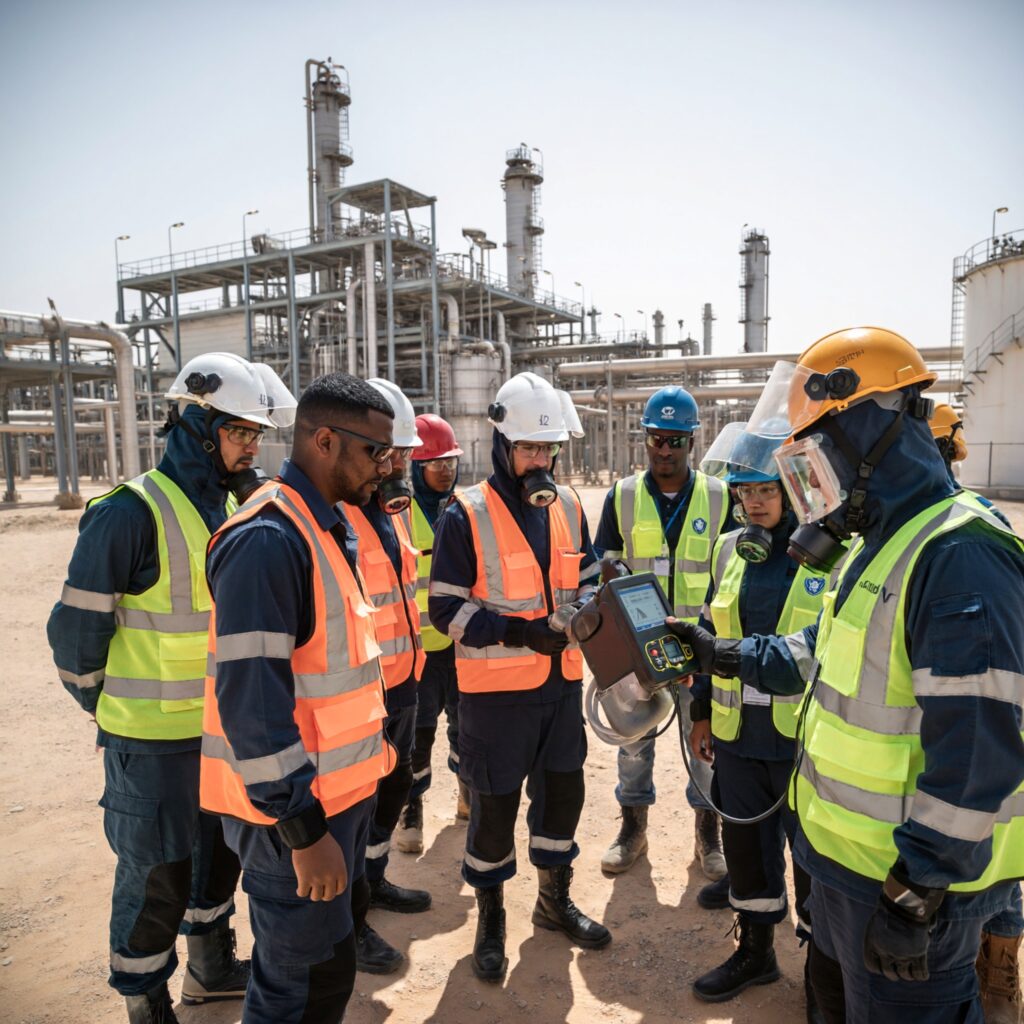
When hydrogen sulfide exposure occurs, seconds count, and a well-executed emergency response can mean the difference between life and death. At Global Arab, our H2S safety courses place tremendous emphasis on developing instinctual response protocols that become second nature during high-stress situations. Our H2S certification program ensures that every graduate understands not just the theoretical framework of emergency response, but can execute life-saving procedures under pressure when faced with actual H2S threats in Saudi industrial settings.
The foundation of effective H2S emergency response begins with the fundamental principles drilled into participants throughout our H2S safety training: Recognize, Retreat, and Report. These three critical actions form the cornerstone of our emergency response philosophy in Global Arab’s H2S safety courses. First, workers must recognize the signs of H2S presence—whether through detector alarms, the smell of rotten eggs at low concentrations, or the sudden odor loss at higher levels. Second, immediate retreat from the contaminated area is essential, moving cross-wind or upwind from the H2S source. Third, reporting the emergency to supervisors and emergency response teams must occur without delay. This straightforward yet critical sequence reinforced throughout our H2S certification program has proven effective in countless real-world H2S incidents across Saudi Arabia’s industrial sectors.
When workers are overcome by H2S exposure, organized rescue operations must commence immediately, but with strict adherence to safety protocols that prevent additional casualties. Global Arab’s H2S safety training dedicates significant portions of the curriculum to teaching proper rescue techniques that balance urgency with responder safety. Our H2S certification program emphasizes that would-be rescuers must never become additional victims, which is why specific rescue protocols form such a critical component of our comprehensive H2S safety courses.
The rescue methodology taught in Global Arab’s H2S safety training follows a structured approach:
Immediate Assessment and Call for Backup: Before initiating any rescue attempt, responders are trained to assess the situation from a safe distance, don appropriate PPE, and call for additional support. This crucial step, emphasized repeatedly in our H2S safety courses, prevents the common tragedy of multiple casualties when unprepared workers rush to assist downed colleagues in H2S-contaminated areas.
Buddy System Rescue Operations: Our H2S certification program teaches that no rescuer should ever enter a potentially H2S-contaminated area alone. The buddy system, with continuous communication and predetermined extraction signals, forms the basis of all rescue operations covered in our H2S safety training. Participants practice these techniques in realistic training scenarios until the procedures become automatic.
Victim Assessment and Immediate Care: Once victims are reached, our H2S safety courses teach rapid assessment techniques to determine the appropriate immediate response. For H2S exposure victims, this includes checking respiratory function, looking for signs of respiratory distress, and immediately moving conscious victims to fresh air while providing oxygen to those showing symptoms of exposure.
The rescue training component of Global Arab’s H2S safety courses goes beyond theoretical knowledge, incorporating realistic drills using training mannequins in simulated H2S environments that mirror conditions found in Saudi oil and gas facilities, refineries, and chemical plants.
Emergency Extraction Techniques: Using specialized equipment and proper body mechanics, rescuers learn to extract victims from confined spaces, elevated positions, and other challenging environments commonly encountered in Saudi industrial facilities. These practical skills, developed through hands-on drills in our H2S safety training, ensure that graduates of our H2S certification program can perform effective rescues even in difficult circumstances.
In any comprehensive H2S safety course, understanding Personal Protective Equipment (PPE) represents a critical line of defense against hydrogen sulfide exposure. At Global Arab, our H2S safety training emphasizes that while engineering controls and administrative measures come first in the safety hierarchy, proper PPE selection and use often make the difference between life and death in H2S-rich environments. Our H2S certification program dedicates significant attention to ensuring participants not only know what equipment to use but understand why specific PPE is necessary for different H2S concentrations.
The foundation of our H2S safety training regarding PPE begins with the crucial understanding that H2S exposure affects the body through two primary routes: inhalation and eye contact. Therefore, effective H2S safety courses must address respiratory protection, eye protection, and in some cases, skin protection simultaneously. Global Arab’s approach to H2S certification ensures workers can match PPE to specific risk scenarios they might encounter in Saudi industrial settings, from minor H2S leaks to full-blown emergency situations where concentrations may exceed 100 ppm. This practical application of knowledge distinguishes our H2S safety training from basic compliance programs, creating safety professionals rather than merely compliant workers.
Respiratory protection forms the cornerstone of H2S PPE, and Global Arab’s H2S safety courses provide exhaustive training on the various types of respiratory equipment suitable for different H2S exposure scenarios. Participants in our H2S certification program receive both theoretical knowledge and hands-on practice with equipment ranging from simple air-purifying respirators to sophisticated supplied-air systems, ensuring they’re prepared for whatever H2S challenges they might face in Saudi Arabia’s diverse industrial landscape.
Our H2S safety training covers three primary categories of respiratory protection:
Air-Purifying Respirators (APRs): For situations where H2S concentrations are known to be below 100 ppm and oxygen levels are sufficient, APRs with appropriate cartridges can provide effective protection. Our H2S safety courses teach participants how to select the correct cartridges for H2S protection, properly fit-test respirators, and recognize when APRs are inappropriate for the H2S hazards present.2.
Supplied-Air Respirators (SARs): In environments where H2S concentrations may exceed 100 ppm or where oxygen deficiency is possible, SARs provide a continuous supply of breathable air from a remote source. Global Arab’s H2S certification includes extensive training on SAR use, maintenance, and limitations, with particular emphasis on the escape provisions required when using these systems in H2S environments.3
Self-Contained Breathing Apparatus (SCBA): For entry into IDLH atmospheres or unknown H2S concentrations, or for emergency response to H2S incidents, SCBA provides the highest level of respiratory protection. Our H2S safety training features comprehensive SCBA donning drills, breathing techniques, and emergency procedures specific to H2S response, ensuring participants develop confidence and competence with this critical equipment.
The hands-on respiratory protection training in Global Arab’s H2S safety courses goes beyond simple equipment familiarization. Participants in our H2S certification program learn to conduct pre-use inspections, recognize equipment defects, perform emergency donning procedures, and understand the limitations of each type of respirator in various H2S scenarios they might encounter in Saudi oil fields, refineries, and processing facilities.
While respiratory protection receives appropriate emphasis in H2S safety training, Global Arab’s H2S safety courses also address the complete ensemble of protective equipment necessary for working safely in H2S-contaminated environments. Our holistic approach to H2S certification ensures workers understand that effective protection extends beyond just breathing apparatus to include eye protection, skin protection, and monitoring equipment integration.
Key components covered in this segment of our H2S safety training include:
Eye and Face Protection: Since H2S gas can cause severe eye irritation and conjunctivitis even at relatively low concentrations, proper eye protection is essential. Our H2S safety courses educate participants on selecting appropriate tight-fitting chemical splash goggles or full facepiece respirators that provide both respiratory and eye protection against H2S exposure.
Protective Clothing: While H2S gas penetration through intact skin is not a primary exposure route, our H2S certification program addresses situations where protective clothing might be necessary, such as when working with liquid H2S or in situations where H2S might be absorbed into clothing and subsequently off-gassed in confined spaces.
Communication Systems: Effective communication while wearing H2S PPE presents unique challenges that our H2S safety training specifically addresses. Participants learn to use voice amplifiers, radio systems, and hand signals to maintain communication while fully equipped with respiratory protection in high-noise industrial environments common in Saudi Arabia.
Integrated Monitoring Systems: Modern H2S PPE often includes integrated monitoring and communication systems. Global Arab’s H2S safety courses stay current with technological advancements, training participants on equipment that combines respiratory protection with real-time H2S monitoring, team communication, and personnel tracking capabilities.
This comprehensive approach to PPE in our H2S certification program ensures that Global Arab graduates understand the integrated nature of protective equipment and can make informed decisions about complete protective ensembles rather than considering individual components in isolation.
The theoretical knowledge imparted in our H2S safety courses comes to life through extensive hands-on PPE training sessions at Global Arab’s specialized training facilities. Our H2S certification program includes realistic scenarios using actual H2S protective equipment in controlled environments that simulate real-world conditions encountered across Saudi industries. This practical application transforms our H2S safety training from abstract concepts to ingrained competencies that become second nature during actual H2S emergencies.
Participants in our H2S safety courses engage in progressive training exercises including:
PPE Donning and Doffing Drills: Proper sequence and technique for donning and removing H2S PPE without contamination is practiced repeatedly in our H2S safety training until it becomes automatic, with timed drills ensuring participants can suit up quickly during genuine emergencies.
Simulated Work Tasks: While fully equipped with appropriate H2S PPE, participants perform typical work tasks in simulated environments, learning to manage equipment limitations while maintaining productivity and safety—a crucial balance emphasized throughout our H2S certification curriculum.
Emergency Scenario Training: Under supervised conditions, trainees respond to simulated H2S emergencies while wearing full protective equipment, developing the confidence and competence needed to function effectively during high-stress situations involving actual H2S threats.
Equipment Limitations Testing: In controlled exercises, participants experience the practical limitations of various H2S PPE, understanding firsthand how reduced mobility, communication challenges, and limited visibility affect their ability to perform tasks and evacuate when necessary.
This emphasis on practical skills ensures that Global Arab’s H2S certification holders don’t just understand H2S PPE theoretically but can perform effectively while fully equipped when faced with real H2S challenges in their workplaces across Saudi Arabia. The muscle memory developed during our H2S safety courses becomes instinctual during actual emergencies, potentially saving lives when seconds count.
When hydrogen sulfide exposure occurs, seconds count, and a well-executed emergency response can mean the difference between life and death. At Global Arab, our H2S safety courses place tremendous emphasis on developing instinctual response protocols that become second nature during high-stress situations. Our H2S certification program ensures that every graduate understands not just the theoretical framework of emergency response, but can execute life-saving procedures under pressure when faced with actual H2S threats in Saudi industrial settings.
The foundation of effective H2S emergency response begins with the fundamental principles drilled into participants throughout our H2S safety training: Recognize, Retreat, and Report. These three critical actions form the cornerstone of our emergency response philosophy in Global Arab’s H2S safety courses. First, workers must recognize the signs of H2S presence—whether through detector alarms, the smell of rotten eggs at low concentrations, or the sudden odor loss at higher levels. Second, immediate retreat from the contaminated area is essential, moving cross-wind or upwind from the H2S source. Third, reporting the emergency to supervisors and emergency response teams must occur without delay. This straightforward yet critical sequence reinforced throughout our H2S certification program has proven effective in countless real-world H2S incidents across Saudi Arabia’s industrial sectors.
When workers are overcome by H2S exposure, organized rescue operations must commence immediately, but with strict adherence to safety protocols that prevent additional casualties. Global Arab’s H2S safety training dedicates significant portions of the curriculum to teaching proper rescue techniques that balance urgency with responder safety. Our H2S certification program emphasizes that would-be rescuers must never become additional victims, which is why specific rescue protocols form such a critical component of our comprehensive H2S safety courses.
The rescue methodology taught in Global Arab’s H2S safety training follows a structured approach:
Immediate Assessment and Call for Backup: Before initiating any rescue attempt, responders are trained to assess the situation from a safe distance, don appropriate PPE, and call for additional support. This crucial step, emphasized repeatedly in our H2S safety courses, prevents the common tragedy of multiple casualties when unprepared workers rush to assist downed colleagues in H2S-contaminated areas.
Buddy System Rescue Operations: Our H2S certification program teaches that no rescuer should ever enter a potentially H2S-contaminated area alone. The buddy system, with continuous communication and predetermined extraction signals, forms the basis of all rescue operations covered in our H2S safety training. Participants practice these techniques in realistic training scenarios until the procedures become automatic.
Victim Assessment and Immediate Care: Once victims are reached, our H2S safety courses teach rapid assessment techniques to determine the appropriate immediate response. For H2S exposure victims, this includes checking respiratory function, looking for signs of respiratory distress, and immediately moving conscious victims to fresh air while providing oxygen to those showing symptoms of exposure.
Emergency Extraction Techniques: Using specialized equipment and proper body mechanics, rescuers learn to extract victims from confined spaces, elevated positions, and other challenging environments commonly encountered in Saudi industrial facilities. These practical skills, developed through hands-on drills in our H2S safety training, ensure that graduates of our H2S certification program can perform effective rescues even in difficult circumstances.
In the heart of Saudi Arabia’s industrial landscape—its vast oil and gas sector—H2S Safety Training Saudi Arabia isn’t just a recommendation; it’s a non-negotiable imperative for survival and compliance. The omnipresent threat of hydrogen sulfide in the Kingdom’s hydrocarbon operations makes specialized H2S Safety Training Saudi Arabia programs, like those offered at Global Arab, fundamental to operational integrity and human safety. For professionals navigating Saudi oil fields, processing plants, and pipelines, understanding why this training is critical begins with recognizing the unique H2S risks embedded in the region’s geology and industry.
The geological formations beneath the Arabian Peninsula are notoriously rich in sulfur, resulting in significant concentrations of H2S—commonly referred to as “sour gas”—in many of Saudi Arabia’s oil and gas reservoirs. This isn’t an occasional hazard; it’s a characteristic of the resource itself. For workers, this means that H2S exposure is a routine occupational risk during:
Exploration and Drilling: When drill bits penetrate sour gas reservoirs, H2S can enter the wellbore unexpectedly, creating sudden, lethal atmospheres. Without proper H2S Safety Training Saudi Arabia, crews may not recognize the early signs—like the tell-tale rotten egg smell at low concentrations—or know that this odor disappears at higher, more dangerous levels, leading to a false sense of security.
Production Operations: From wellheads to gathering stations, H2S is present wherever sour crude or gas is handled. Equipment leaks, valve failures, or accidental releases during sampling and maintenance can quickly escalate. Effective H2S Safety Training Saudi Arabia teaches workers to identify potential release points, understand gas behavior (it’s heavier than air and collects in low-lying areas), and execute immediate containment protocols.
Turnarounds and Maintenance: Some of the highest-risk exposures occur when systems are shut down and opened for servicing, potentially releasing trapped H2S. A comprehensive H2S Safety Training Saudi Arabia program, like Global Arab’s, drills crews in lockout-tagout (LOTO), atmospheric testing, and confined space entry procedures specific to H2S environments.
The consequence of underestimating these risks is severe. H2S inhibits cellular respiration; exposure to concentrations as low as 500-700 ppm can cause rapid unconsciousness, respiratory paralysis, and death within minutes. This is why H2S Safety Training Saudi Arabia is critical—it transforms theoretical awareness into instinctual, life-saving action.
As the steward of the Kingdom’s petroleum resources, Saudi Aramco sets the gold standard for safety, and its H2S protocols are exhaustive. Compliance is not optional for any personnel on Aramco assets. For contractors and employees, enrolling in a recognized H2S Safety Training Saudi Arabia course that meets Aramco’s specifications is the first step to site access.
Aramco’s safety engineering procedures, particularly SAEP-11 (Safety Requirements for H2S Operations), dictate stringent requirements that shape quality H2S Safety Training Saudi Arabia. These include:
Certification Validity and Specificity: Aramco mandates that H2S safety certification be current (typically renewed every 1-2 years) and often requires site-specific training modules. Global Arab’s H2S Safety Training Saudi Arabia curriculum is designed to meet this, covering Aramco’s specific emergency alarm signals, muster procedures, and the use of Aramco-approved breathing apparatus and detectors.
Competency-Based Training: It’s not enough to simply attend a course. Aramco requires demonstration of competency. Our H2S Safety Training Saudi Arabia program at Global Arab emphasizes hands-on, practical drills—like donning SCBA (Self-Contained Breathing Apparatus) under simulated stress or performing a rescue drag in full PPE—ensuring skills are muscle memory, not just notes on a page.
Documentation and Compliance Tracking: Aramco audits contractor safety records rigorously. Completing a reputable H2S Safety Training Saudi Arabia program provides the verifiable documentation needed to prove compliance. Global Arab provides detailed training records and certificates that satisfy Aramco’s administrative requirements, giving both individuals and their companies peace of mind.
In essence, H2S Safety Training Saudi Arabia that is aligned with Aramco standards is a passport to work in the Kingdom’s most vital industry. It signals to Aramco that a worker is prepared, vigilant, and values the safety culture that Aramco enforces.
Beyond corporate policies, the Kingdom of Saudi Arabia has established a robust legal framework to protect worker safety, with clear implications for H2S handling. A professional H2S Safety Training Saudi Arabia course educates workers and employers on these legal obligations, turning compliance into a structured practice.
Key provisions under the Saudi Labor Law and related regulations include:
Employer’s Duty of Care (Article 83): The law mandates that employers provide a safe workplace, free from health hazards. This includes identifying H2S risks, implementing control measures, and crucially, providing adequate training. Employers who enroll their teams in accredited H2S Safety Training Saudi Arabia programs, such as Global Arab’s, actively fulfill this legal duty and mitigate liability.
Provision of Information and Instruction (Article 85): Employers must inform workers about workplace hazards and the precautions necessary. Comprehensive H2S Safety Training Saudi Arabia is the primary vehicle for this instruction, covering the properties of H2S, exposure limits, and emergency response plans as required by law.
Operational Regulations for Hazardous Substances: Regulations from bodies like the Royal Commission for Jubail and Yanbu (RCJY) and the Saudi Civil Defense impose specific requirements for handling toxic gases like H2S. These often mandate the presence of a certain number of H2S-certified personnel on-site, certified emergency response teams, and approved equipment. Global Arab’s H2S Safety Training Saudi Arabia prepares organizations to meet these operational codes.
Failure to comply with these laws can result in severe penalties for companies, including heavy fines, project stoppages, and even imprisonment for gross negligence leading to injury or death. For the worker, the right to refuse unsafe work is protected, but this right is empowered by knowledge—knowledge gained through proper H2S Safety Training Saudi Arabia.
For Saudi oil and gas professionals, H2S Safety Training Saudi Arabia is the critical foundation upon which personal safety and operational excellence are built. It bridges the gap between the inherent H2S risks in Saudi fields, the rigorous requirements of industry giants like Aramco, and the protective mandate of Saudi labor law.
Global Arab stands at the intersection of these needs, delivering H2S Safety Training Saudi Arabia that is more than just certification. It is an immersive preparation for reality. Our courses equip professionals not only to protect their own lives but also to uphold the safety standards that allow Saudi Arabia’s most important industry to thrive responsibly. In an environment where H2S is a constant companion, the right training isn’t just critical—it’s everything.
Ready to meet the standard? Explore Global Arab’s accredited H2S Safety Training Saudi Arabia programs and ensure your team is trained, compliant, and confident.
We deliver internationally recognized safety training and professional inspection solutions.
From workplace safety to equipment compliance, our certified experts ensure quality and trust.
Serving Saudi Arabia and the Gulf region with global standards.
Your safety, knowledge, and success are our priority.
