Top HSE Training Courses in Saudi Arabia: Complete Guide for 2025
دورات تدريبية في الصحة والسلامة والبيئة في المملكة العربية السعودية
Home / HSE Training
Home / HSE Training
In today’s fast-changing industrial world, health, safety, and environment (HSE) training has become essential for organizations in Saudi Arabia. With the Kingdom’s strong presence in oil & gas, construction, manufacturing, and logistics, workplace safety is not just a legal requirement—it’s a moral responsibility.
Employers are investing heavily in HSE training courses in Saudi Arabia to meet international and local saudi standards, reduce accidents, and improve employee well-being. Whether you’re an employer, safety professional, or an individual seeking career growth, choosing the right course can significantly enhance your skills and employability.
In this comprehensive guide, we’ll cover:
If you’re watching the incredible growth of projects like NEOM, the Red Sea Global, and Qiddiya, you’ve likely noticed a common thread: an uncompromising focus on Health, Safety, and Environment (HSE). This isn’t a coincidence; it’s a fundamental shift. For ambitious professionals in Saudi Arabia, an HSE certification has transitioned from a “nice-to-have” to a “non-negotiable” for career advancement in construction, oil & gas, manufacturing, and beyond.
Think of it as learning the universal language of safety that every major Saudi employer—from Aramco and SABIC to the giga-project contractors—now demands. It’s the key that unlocks site access, managerial responsibilities, and significantly higher earning potential.
| Career Stage | Key Certification(s) | Typical Job Title in KSA | Years of Experience | Estimated Monthly Salary Range (SAR) |
|---|---|---|---|---|
| Entry / Site Level | OSHA 30-Hour, Basic First Aid | Safety Attendant, Trainee Officer | 0-2 | 3,000 – 5,500 |
| Supervisor / Officer | NEBOSH IGC, IOSH Managing Safely | HSE Officer, Safety Supervisor | 2-5 | 7,000 – 12,000 |
| Manager / Advisor | NEBOSH Diploma, Specialized Certs (e.g., CSP) | HSE Manager, HSE Advisor | 5-10 | 15,000 – 25,000+ |
| Senior Director / Consultant | NEBOSH Dip, Chartered Status (CFIOSH), Audit Certs | HSE Director, Lead Consultant | 10+ | 30,000 – 50,000+ |
While many talk about HSE certificates, few discuss the strategic advantage they create for both professionals and companies in Saudi Arabia’s booming economy. In the era of Vision 2030, HSE training has evolved from a regulatory checkbox to a core business strategy.
For Companies Investing in Their Workforce:
Why are Saudi giants like Aramco, SABIC, and NEOM contractors so inflexible about HSE certifications? It’s simple math.
Risk Mitigation: A single worksite incident can cost millions in delays, fines, and reputational damage. Certified HSE professionals are your first line of defense.
Winning More Business: A team with documented HSE competence is more likely to win tenders, especially on government and giga-projects where safety records are a key selection criterion.
Operational Excellence: A safe site is an efficient site. Proper HSE practices reduce downtime, lower insurance premiums, and boost overall productivity.
For Professionals Building a Future-Proof Career:
Your HSE certification is more than a line on your CV; it’s a signal to employers that you think differently.
The Leadership Differentiator: NEBOSH and IOSH certified individuals are trained to anticipate problems, not just react to them. This proactive mindset is what separates a manager from a leader.
Career Resilience: As Saudi Arabia diversifies its economy, HSE skills are transferable across sectors—from oil and gas to construction, manufacturing, and even healthcare. Your investment in HSE training today keeps your career relevant tomorrow.
The Trust Factor: Holding a recognized certification like NEBOSH in Saudi Arabia instantly builds credibility with employers, clients, and colleagues. It’s a universal language of competence and care.
At Globalarab, we design our HSE training courses in Saudi Arabia with this strategic mindset. We prepare you not just to pass an exam, but to become a value-driven asset to any forward-thinking Saudi organization.
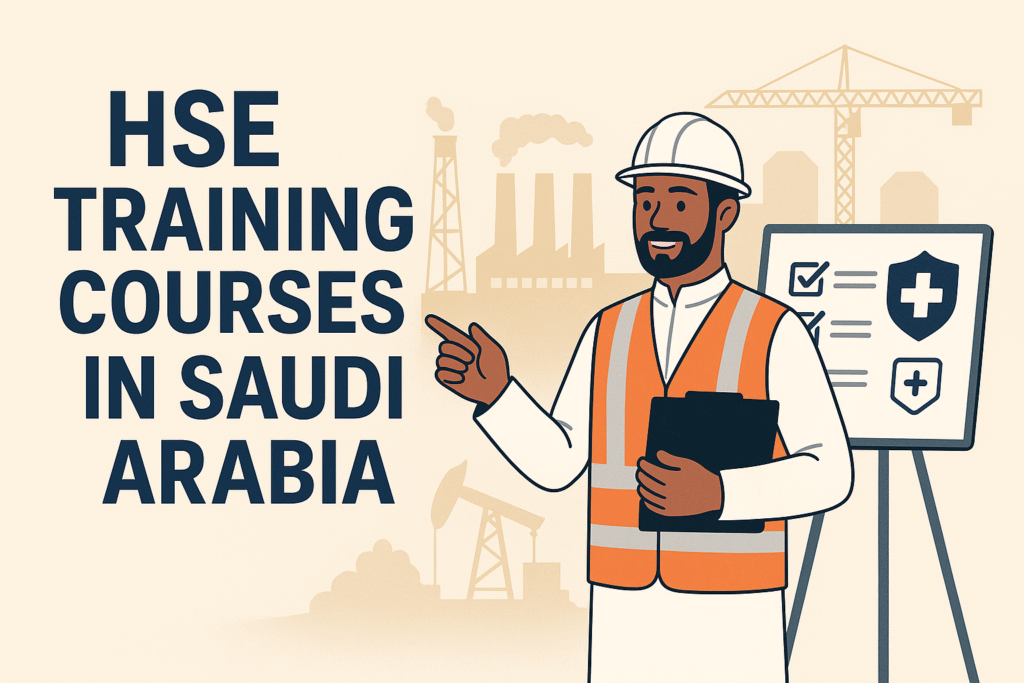
HSE (Health, Safety, and Environment) training refers to structured programs designed to teach individuals and organizations how to:
Saudi Arabia’s Vision 2030 emphasizes workplace safety and environmental sustainability. Industries such as oil & gas, construction, and petrochemicals employ thousands of workers in high-risk environments. Trained HSE professionals are in high demand, making HSE training courses Saudi Arabia a strong career path.
We understand that choosing between NEBOSH, IOSH, and OSHA can be confusing. Let’s demystify it. The right choice isn’t about the “best” certificate; it’s about the best certificate for you at your current career stage.
You are a professional aiming for the top (HSE Manager, Advisor, or Consultant).
Your Destination: NEBOSH IGC. This is the gold standard, the comprehensive qualification that builds the strategic framework for leading an organization’s entire safety culture. It’s challenging, but it’s the direct route to the most respected and highly-paid roles.
You are a supervisor, team leader, or manager needing to integrate safety into your daily leadership.
Your Destination: IOSH Managing Safely. This course is a game-changer for those who manage teams and operations. It translates safety principles into practical management actions, teaching you how to manage risks and protect your people effectively.
You are a worker, technician, or new entrant who needs foundational safety knowledge to work safely on site.
Your Destination: OSHA 10-Hour or 30-Hour. This is your essential passport to site entry. It provides the fundamental, hands-on knowledge of workplace hazards and how to avoid them.
Still unsure? A simple way to think about it: OSHA teaches you to be safe, IOSH teaches you to manage safety, and NEBOSH teaches you to lead safety.
The Business Case for HSE: Calculating Your True Return on Investment (ROI) in Saudi Arabia
For business leaders in Saudi Arabia, investing in HSE training courses is a critical financial decision, not just a regulatory one. To move beyond seeing it as a cost, you need to understand the comprehensive Return on Investment (ROI). The true value extends far beyond avoiding fines.
Let’s break down the ROI into tangible and strategic gains:
1. The Direct Cost Savings (The “Hard” ROI):
| Cost of an Incident | vs. | Cost of Prevention |
|---|---|---|
| Medical & Compensation Fees: Immediate payouts for injuries. | → | Training Investment: A one-time, predictable cost per employee. |
| Regulatory Fines: Penalties from the Saudi Ministry of Human Resources for non-compliance. | → | Audit Preparedness: Certified staff ensure continuous compliance, eliminating fine risk. |
| Production Downtime: Work stoppages during investigation and cleanup. | → | Operational Efficiency: A safe site has fewer disruptions, protecting project timelines. |
| Insurance Premiums: Yearly costs that can skyrocket after claims. | → | Premium Reductions: Many insurers offer lower rates for companies with certified safety programs. |
| Reputational Damage: Loss of trust with clients and the public. | → | Enhanced Reputation: A strong safety record becomes a key differentiator in bids. |
2. The Strategic & Competitive ROI (The “Soft” Advantages):
Winning Major Contracts: For Vision 2030 projects (NEOM, Red Sea, Qiddiya), demonstrating a team with certified HSE competence is often a mandatory pre-qualification requirement. Your training investment directly unlocks access to these lucrative tenders.
Attracting & Retaining Top Talent: Skilled professionals prefer to work for safe, responsible companies. A robust HSE culture reduces turnover and its associated recruitment costs.
Boosting Productivity & Morale: Employees who feel safe are more engaged, focused, and less likely to be absent. This directly translates to higher quality work and output.
The Globalarab Advantage: Our HSE training courses in Saudi Arabia are designed with this business ROI in mind. We don’t just issue certificates; we equip your team with the practical, Saudi-specific skills to proactively manage risk, prevent costly incidents, and become a tangible asset that contributes to your company’s profitability and growth. Investing in quality HSE training is one of the most impactful decisions you can make for your company’s future in the Kingdom.
For business leaders in Saudi Arabia, every investment must be justified. While the moral and safety case for HSE training is clear, the financial case often needs to be quantified in terms that resonate with CFOs and budget committees. Use this practical framework to calculate the specific Return on Investment your organization can expect from quality HSE Training Courses in Saudi Arabia .
The Basic ROI Formula:
ROI = (Cost Avoided + Value Gained) ÷ Total Training Investment × 100
Step 1: Calculate Your Total Training Investment
| Investment Component | Calculation | Your Figure (SAR) |
|---|---|---|
| Direct Course Fees | Number of employees × course fee per person | _____ |
| Staff Time Cost | Training hours × average hourly wage (including benefits) | _____ |
| Administrative Time | Hours spent coordinating × coordinator hourly rate | _____ |
| Travel & Related Expenses | Transportation, accommodation, meals if applicable | _____ |
| TOTAL INVESTMENT | Sum of all above | _____ |
Step 2: Calculate Cost Avoided (The Incidents You Prevent)
Use Saudi-specific incident cost data to estimate what you’re preventing:
| Incident Type | Average Direct Cost (SAR) | Hidden Costs (3-5× Direct) | Total Potential Cost |
|---|---|---|---|
| Minor Injury (First aid only) | 500 – 2,000 | 1,500 – 10,000 | 2,000 – 12,000 |
| Lost Time Injury (LTI) | 15,000 – 50,000 | 45,000 – 250,000 | 60,000 – 300,000 |
| Serious Incident (Hospitalization) | 100,000 – 500,000 | 300,000 – 2.5M | 400,000 – 3M |
| Fatality or Permanent Disability | 500,000 – 2M+ | 1.5M – 10M+ | 2M – 12M+ |
Sources: Saudi Ministry of Human Resources and Social Development industry reports, insurance industry data
Estimated Annual Cost Avoided: Based on your industry and workforce size, estimate the number of incidents your training program will prevent. Multiply by the average cost above.
| Industry | Typical Annual Incident Reduction with Certified HSE Team |
|---|---|
| Construction | 40-60% reduction in recordable incidents |
| Oil & Gas | 50-70% reduction in process safety events |
| Manufacturing | 30-50% reduction in lost-time injuries |
| General Industry | 25-45% reduction in all incident types |
Your Estimated Annual Cost Avoided: _____ SAR
Step 3: Calculate Value Gained (The Competitive Advantages)
| Value Driver | Calculation Method | Your Figure (SAR) |
|---|---|---|
| Insurance Premium Reduction | Many Saudi insurers offer 5-15% discounts for certified safety programs. Multiply your annual premium by the discount percentage. | _____ |
| Tender Success Value | What percentage of your contracts require certified HSE personnel? Estimate the value of one additional contract win per year attributable to your safety credentials. | _____ |
| Productivity Gain | Safe sites are 10-20% more productive due to less disruption. Estimate 5% of your annual payroll as a conservative productivity gain. | _____ |
| Retention Savings | Reduced turnover from better safety culture. Calculate 20% of annual salary for each retained employee you would have lost. | _____ |
| TOTAL VALUE GAINED | Sum of all above | _____ |
Step 4: Calculate Your Total ROI
| Component | Your Figure (SAR) |
|---|---|
| Total Investment (from Step 1) | _____ |
| Total Cost Avoided (from Step 2) | _____ |
| Total Value Gained (from Step 3) | _____ |
| TOTAL BENEFIT (Cost Avoided + Value Gained) | _____ |
| NET BENEFIT (Total Benefit – Total Investment) | _____ |
| ROI PERCENTAGE (Net Benefit ÷ Total Investment × 100) | _____% |
Real-World Example:
A Jubail petrochemical support company with 200 employees invested SAR 85,000 in comprehensive HSE Training Courses in Saudi Arabia for their supervisory and management team. Their calculated ROI:
Total Investment: SAR 85,000
Cost Avoided (preventing 2 LTIs and multiple minor incidents): SAR 320,000
Value Gained (insurance discount + new contract wins): SAR 210,000
Total Benefit: SAR 530,000
Net Benefit: SAR 445,000
ROI: 524%
The Globalarab Advantage:
We provide every corporate client with a customized ROI worksheet and consultation to help you gather the right data before training. This allows you to measure actual results afterward and demonstrate the tangible value of your investment in HSE Training Courses in Saudi Arabia to stakeholders. Contact us for assistance in calculating your specific ROI.
When considering HSE training in Saudi Arabia, organizations typically fall into one of two categories: those seeking a certificate for compliance and those building a culture of safety. The distinction is critical, and your goal determines the type of training you need, the provider you choose, and the long-term value you receive.
The Compliance-First Approach (The Minimum Viable Path):
Goal: To meet the legal requirements of the Saudi Ministry of Human Resources and Social Development (MHRSD), Civil Defense, and client demands (e.g., Saudi Aramco contractor pre-qualification).
Focus: Obtaining the necessary certificates for a specific number of employees at the lowest acceptable cost.
Outcome: Legal “checkmarks” are achieved, but workplace safety practices may not fundamentally change. This approach carries hidden risks, as a paper-based safety system often fails under real pressure.
The Culture-First Investment (The Strategic Advantage Path):
Goal: To embed safety as a core value and a competitive advantage. It’s about preventing incidents, not just passing audits.
Focus: Developing practical competence, leadership skills, and proactive risk thinking at all levels, from new hires to senior management.
Outcome: A measurable reduction in incidents, lower insurance premiums, enhanced reputation for winning Vision 2030 project tenders, and a workforce that is genuinely safer, more engaged, and more productive.
The Globalarab Differentiator:
Our HSE training courses in Saudi Arabia are engineered for organizations and professionals on the second path. We provide the certificates you need for compliance, but more importantly, we deliver the practical skills, leadership frameworks, and Saudi-specific case studies that transform a workforce. We help you build a safety culture where every employee feels responsible and empowered—the only sustainable way to protect your people and your projects.
IOSH (Institution of Occupational Safety and Health)
OSHA Training تدريب اوشا
First Aid & Fire Safety Training تدريب الإسعافات الأولية ومكافحة الحرائق
Environmental Safety Training
Duration and Cost of HSE Training in Saudi Arabia
Costs vary depending on the course and provider:
IOSH Managing Safely:
Duration: 3–5 days | Cost: SAR 1,200–1,500
OSHA 30-hour Training:
Duration: 1 week | Cost: SAR 1,200–1,500
Basic Fire & First Aid Courses:
Duration: 1–3 days | Cost: SAR 400–800
Pro Tip: Many providers now offer online HSE training courses in Saudi Arabia, making it flexible for professionals who cannot attend in person.
In a competitive Saudi job market, a certificate alone isn’t enough. What sets our graduates apart is the practical, Saudi-specific competency they develop through our training—the exact skills Saudi employers like Aramco, NEOM contractors, and major construction firms actively seek.
Our graduates stand out because they learn:
The Saudi Compliance Bridge: While most courses teach international standards, we show you exactly how to apply them within Saudi Labor Law, Civil Defense regulations, and specific company requirements like Saudi Aramco’s contractor safety management system. This means you can demonstrate compliance from day one.
Real-World Risk Assessment Skills: We don’t just teach theory. Using actual case studies from Saudi industrial sites, you’ll learn to conduct practical risk assessments for common Saudi scenarios: working in extreme heat, managing multicultural teams, and navigating the safety challenges of fast-track giga-projects.
Cultural Competence in Safety Leadership: Safety communication in Saudi Arabia requires specific skills. We teach you how to effectively implement safety protocols within local workplace dynamics, ensuring your safety initiatives are respected and followed by all team members.
This practical focus is why companies prefer Globalarab-certified professionals—because you’re not just trained, you’re job-ready for the Saudi market.
Anyone can teach you the rules. But true expertise in Health, Safety, and Environment (HSE) is about what happens between the lines of the textbook. It’s the “silent skills” that transform a certified professional into a true safety leader on a Saudi worksite.
When you invest in the right HSE training Saudi Arabia program, you gain these crucial, unspoken abilities:
The Confidence to Speak Up: The real test isn’t the exam; it’s having the courage to calmly say “Stop” when you see an unsafe act, even when facing pressure to meet a deadline. Quality training builds this moral authority, teaching you how to communicate concerns effectively and respectfully within the hierarchical structures common in Saudi businesses.
Pre-Incident Investigation: Most training teaches you what to do after an incident. The best training teaches you how to “investigate” near-misses and subtle at-risk behaviors before they turn into tragedies. You learn to read the “story” the worksite is telling you every single day.
The Art of Influence: HSE isn’t about policing; it’s about persuading. We focus on how to make your colleagues want to be safe. This means understanding what motivates different people—from a project manager focused on deadlines to a worker focused on task completion—and framing safety as the solution to their goals, not an obstacle.
These skills are what employers at companies like Aramco and NEOM are truly looking for. They don’t just need people who know the rules; they need leaders who can positively influence the entire safety culture. This is the core of the practical, human-centric approach we embed in every HSE training Saudi Arabia course at Globalarab.
Completing HSE training can open doors to multiple roles:
HSE Officer / HSE Engineer
Safety Supervisor / Safety Inspector
Risk Manager
Environmental Compliance Officer
Fire Safety Specialist
Average salaries for HSEprofessionals in Saudi Arabia range from SAR 8,000 to SAR 18,000 per month, depending on qualification and experience.
Benefits of HSE Training for Employers in Saudi Arabia
Reduced workplace accidents → lower insurance and compensation costs
Higher compliance with Saudi labor laws and international standards
Improved employee morale and productivity
Stronger company reputation → more contracts and clients
How to Choose the Right HSE Course in Saudi Arabia
When selecting a course, consider:
Accreditation: Ensure the course is recognized globally ( IOSH, OSHA, Highfield).
Location: Choose a provider near Riyadh, Jeddah, or Dammam for convenience.
Format: Decide between classroom, blended, or fully online learning.
Trainer Expertise: Experienced trainers bring real-life industry examples.
Cost vs. Value: Don’t just go for the cheapest option—look for long-term career benefits.
When considering HSE training, the focus often lands on course fees and potential salary increases. However, the true Return on Investment (ROI) for both individuals and companies in Saudi Arabia is far more comprehensive. Understanding this full value turns training from an expense into a strategic investment.
For the Ambitious Professional:
Your ROI includes tangible and intangible assets that build career capital:
Career Velocity: HSE certification is the fastest way to transition from a technical/operational role into a specialized, respected management-track position. It shortcuts years of gradual promotion.
Job Security & Mobility: In a market prioritizing Saudization (Nitaqat), holding in-demand certifications makes you a preferred national candidate. Your skills are also transferable across oil & gas, construction, and manufacturing—insulating you from industry-specific downturns.
Professional Credibility: A certificate from a recognized provider like Globalarab acts as a trust signal. It tells employers you are committed to global best practices and understand local Saudi compliance, saving them time and risk.
For the Forward-Thinking Company:
The financial ROI extends well beyond avoiding fines:
The Cost of an Incident vs. The Cost of Training: A single lost-time injury can cost hundreds of thousands in direct costs (medical, compensation) and indirect costs (production delays, investigation time, morale loss). Training your team is a fraction of this cost and is your primary risk mitigation strategy.
Winning Business: For giga-projects under Vision 2030 (NEOM, Red Sea, Qiddiya), a demonstrably competent HSE team is a prerequisite for pre-qualification and tender success. Your training investment directly unlocks new revenue streams.
Operational Excellence: A safe site is an efficient site. Proper HSE practices reduce rework, lower equipment damage, minimize absenteeism, and improve overall workflow—directly boosting productivity and profit margins.
At Globalarab, we design our HSE training courses in Saudi Arabia with this holistic ROI in mind. We prepare you to deliver value that appears not just on your payslip, but on your company’s balance sheet and project win rate.
With so many options, making the final choice can be tough. Don’t gamble with your career or your company’s safety standards. Use this actionable checklist to evaluate any HSE training provider before you enroll.
1. Verify the “Triangle of Trust”:
A legitimate provider must have proof of:
International Accreditation: (e.g., NEBOSH, IOSH) for the specific course you need.
Local Saudi Recognition & Experience: Do they understand Saudi Labor Law, Civil Defense codes, and major company standards (Aramco, etc.)?
Proven Track Record: Ask for verifiable pass rates and recent student testimonials from professionals in the KSA market.
2. Scrutinize the Trainer’s Real-World Profile:
The instructor’s CV is as important as the course content. Ask: Do the trainers have:
Saudi-Specific Experience? Have they actually managed HSE on projects within the Kingdom?
Recent Industry Experience? Safety standards evolve; is their frontline knowledge current?
3. Look Beyond the Price Tag for True ROI:
The cheapest option is often the most expensive mistake. Calculate the true value, which includes:
First-Time Pass Rate: A high rate indicates quality teaching and support.
Post-Training Support: Do they offer career guidance or help with the certification process?
4. Demand Transparency on Outcomes:
A confident provider is transparent. They should be able to tell you:
Typical career paths their graduates take in Saudi Arabia.
The specific skills you will be able to demonstrate on day one of a new job.
5. Assess Their Commitment to Your Success:
The right partner demonstrates this through:
Accessible support for your questions during the course.
A professional learning environment, whether online or at their training centers.
How Globalarab Measures Up: We welcome this scrutiny. We built our reputation across Saudi Arabia by excelling in every one of these five areas. Compare us against any other provider using this checklist.*
Anyone can offer a training course. At Globalarab, we provide a career-transforming experience rooted in the realities of the Saudi market. Here’s what that means for you:
Context is King: We don’t just teach international standards; we show you how to apply them within the specific framework of Saudi Labor Law, Civil Defense regulations, and the stringent requirements of companies like Aramco and SABIC. You learn global best practices, filtered through a local lens.
Learning from Practitioners, Not Just Theorists: Our instructors are seasoned HSE professionals who have managed safety on Saudi sites. They bring you real-world case studies, not just textbook examples. You’ll learn from their mistakes and successes, gaining insights you simply can’t get from a book.
A Community, Not Just a Classroom: When you train with us, you join a network of thousands of HSE professionals across the Kingdom. The connections you make during your course can become your most valuable professional asset.
Anyone can offer a training course. At Globalarab, we provide a career-transforming experience rooted in the realities of the Saudi market. Here’s what that means for you:
Context is King: We don’t just teach international standards; we show you how to apply them within the specific framework of Saudi Labor Law, Civil Defense regulations, and the stringent requirements of companies like Aramco and SABIC. You learn global best practices, filtered through a local lens.
Learning from Practitioners, Not Just Theorists: Our instructors are seasoned HSE professionals who have managed safety on Saudi sites. They bring you real-world case studies, not just textbook examples. You’ll learn from their mistakes and successes, gaining insights you simply can’t get from a book.
A Community, Not Just a Classroom: When you train with us, you join a network of thousands of HSE professionals across the Kingdom. The connections you make during your course can become your most valuable professional asset.
Yes, many providers offer online and blended learning options.
For high-risk industries like oil & gas and construction, basic safety training is mandatory.
From 1-day workshops to 15-day advanced certifications, depending on the course type.
IOSH Managing Safely and NEBOSH IGC OSHA are ideal starting points
HSE courses and training are conducting in Arabic, English, Urdu, Hindi
A: NEBOSH is challenging because it is comprehensive and respected. The key to success isn’t just memorization; it’s understanding how to apply knowledge. Our pass rates are well above the global average because we focus on application through workshops, mock exams, and continuous tutor support, ensuring you are truly prepared.
A: Let’s talk numbers. Our internal data and alumni surveys show that professionals with a NEBOSH certification typically see a salary increase of 25-40% upon moving into a new role. For IOSH, it’s often 15-25%. Beyond salary, the ROI includes job security, increased responsibility, and the invaluable peace of mind that comes from knowing you can prevent incidents and save lives.
A: This is crucial. Always ask for two things:
1. The center’s accreditation proof from the awarding body (e.g., NEBOSH, IOSH).
2. The specific course code for the qualification you’re taking (e.g., NEBOSH IG1, IG2).
You can then verify this code on the official awarding body website. We are transparent and proud to provide this information.
The Saudi market of 2025 is not the same as 2020. With Vision 2030 accelerating, the risks, technologies, and regulations are evolving faster than ever. A certificate is a snapshot of your knowledge at one point in time. A future-proof career is built on a foundation of adaptable learning.
Here’s what sets a modern, resilient HSE professional apart in today’s Kingdom:
1. Digital & Environmental Literacy:
The future of HSE isn’t just hard hats and safety boots. It’s about understanding:
Digital Risk: Cybersecurity for operational technology, data privacy in incident reporting.
EHS Software: Using modern platforms for data analysis to predict and prevent incidents.
Sustainability (ESG): Integrating environmental management with traditional safety, a huge growth area driven by Saudi Green Initiative goals.
2. Specialization vs. Generalization:
While a NEBOSH IGC provides a fantastic foundation, the highest-value professionals often develop a specialty. The right HSE training Saudi Arabia provider should help you see the pathways ahead:
Process Safety Management (PSM): For those in oil, gas, and chemicals.
Construction Safety Management: Specializing in the unique risks of giga-projects.
Occupational Health & Hygiene: Going beyond physical safety to long-term worker wellness.
3. Building a Learning Network:
Your learning shouldn’t stop when the course ends. The most successful professionals are those who are continuously learning from their peers. When you choose a training provider, you’re also choosing a community.
The Globalarab Commitment to Your Future:
We design our HSE training Saudi Arabia courses with this evolving landscape in mind. Our curriculum incorporates forward-thinking topics, and our instructors provide guidance on these emerging career paths. More importantly, we connect you with a network of alumni and industry experts, ensuring you have the resources to adapt and lead for years to come. Don’t just get certified for a job today; build a career for the Saudi Arabia of tomorrow.
The true value of HSE training isn’t the certificate—it’s the tangible impact you can make immediately. Here’s a practical, phased plan our graduates use to apply their new skills from day one on a Saudi worksite.
Weeks 1-2: The Proactive Observer
Conduct a “Fresh Eye” Site Walk: Use a simple checklist to identify just three priority hazards (e.g., unguarded machinery, blocked exits, improper PPE use).
Start One Safety Conversation: Instead of giving orders, use the phrase: “I was reviewing our HSE training and noticed we could try X to make this task safer. What do you think?”
Month 1: The Systematic Contributor
Lead a 10-Minute Toolbox Talk: Use a provided template on a relevant, high-frequency risk like heat stress or manual handling.
Document and Analyze One ‘Near-Miss’: Practice turning a minor incident into a learning opportunity for the team without assigning blame.
Months 2-3: The Valued Advisor
Develop a One-Page Improvement Plan: Present a simple, data-backed suggestion to your manager (e.g., “Implementing visual floor markings in Area Y could reduce trip hazards by 40%”).
Mentor a New Colleague: Share one key safety procedure you mastered during your training.
This is the Globalarab Difference: We equip you not just with theory, but with a clear, confidence-building roadmap to create visible value and assert your expertise from your very first week back at work.
Bridging the Confidence Gap: How to Move from “Knowing” to “Doing”
You’ve passed the exam. You have the certificate. But on your first day back at the site, a voice in your head whispers: “Do I really know enough to speak up? What if I’m wrong?” This “confidence gap” between theoretical knowledge and practical action is normal, but it can paralyze even the most qualified professionals.
Here’s how to bridge that gap and transition from a certified learner to a confident practitioner:
Start Small, Win Fast: Your goal on Monday is not to overhaul the entire safety management system. It’s to have one small, successful safety interaction. This could be:
Politely pointing out a single, clear violation (e.g., “Ahmed, I think your harness latch isn’t fully closed—can we double-check it?”).
Successfully completing a routine inspection checklist with more depth than before.
Answering one colleague’s question correctly by referencing your training.
Your Path: OSHA Certification → IOSH Managing Safely → Site Safety Experience
Goal: Become a certified Safety Officer or HSE Coordinator
Timeline: 3-6 months to certification
Expected Saudi Salary Range: 8,000 – 15,000 SAR/month
Your Path: NEBOSH International General Certificate → Specialized Training
Goal: Advance to HSE Engineer, Advisor, or Supervisor
Timeline: 4-8 months to complete
Expected Saudi Salary Range: 15,000 – 25,000 SAR/month
Your Path: NEBOSH Diploma → Professional Development
Goal: Become HSE Manager, Consultant, or Corporate Safety Director
Timeline: 12-18 months progression
Expected Saudi Salary Range: 25,000 – 40,000+ SAR/month
92% of our NEBOSH graduates report career advancement within 6 months of certification
Average salary increase of 35% for professionals completing our HSE training programs
100% compliance with Saudi Ministry of Human Resources requirements
Book a Free Career Consultation with our Saudi HSE advisors
Download Our HSE Career Guide specific to Saudi market opportunities
Visit Our Training Centers in Riyadh, Jeddah, or Dammam
The demand for HSE training courses in Saudi Arabia is rapidly growing as industries align with Vision 2030 and international safety standards. By investing in the right training, professionals can boost their career prospects, and companies can ensure compliance, safety, and productivity.
If you’re serious about workplace safety and career growth, now is the time to enroll in an HSE training course in Saudi Arabia. Whether you choose NEBOSH, IOSH, OSHA, Highfield or specialized safety programs, the skills you gain will benefit both you and your organization.
We deliver internationally recognized safety training and professional inspection solutions.
From workplace safety to equipment compliance, our certified experts ensure quality and trust.
Serving Saudi Arabia and the Gulf region with global standards.
Your safety, knowledge, and success are our priority.
